Summary: Anti-botnet software detects and blocks malicious automated traffic across websites, mobile apps, and APIs. Best overall: Radware Bot Manager; also strong contenders: Cloudflare Bot Management, DataDome, and Imperva Advanced Bot Protection.
What is Anti-Botnet Software?
Anti-bot software helps protect digital platforms from malicious bot attacks by detecting and mitigating suspicious or automated bot activity. This software is crucial for online businesses to prevent harm to their digital assets from bots attempting to perform activities like credential stuffing, content scraping, and DDoS attacks.
Anti-bot software is designed to differentiate between legitimate human users and automated bots accessing a website, mobile application, or API. It aims to block or manage bot traffic that can be used for malicious purposes.
Anti-bot solutions have two primary aspects:
- Detection: Anti-bot solutions use various techniques, including machine learning, behavioral analysis, and threat intelligence, to identify bot activity.
- Mitigation: Once a bot is identified, the software can take action to block or limit its access, preventing it from causing harm.
Common features of anti-bot software:
- Real-time detection and response: This allows for immediate action against emerging threats, minimizing potential damage.
- Behavioral and interaction analysis: This helps reduce both false positives and false negatives.
- Adaptability: The software needs to be able to learn from evolving bot techniques and adjust its defenses accordingly.
- Comprehensive coverage: It should address various attack vectors, including DDoS attacks, credential stuffing, and content scraping.
- Integration: Easy integration with existing systems is important for efficient implementation.
- Scalability: The solution should be able to handle increasing traffic volumes without performance degradation.
Editor's note: This article has been updated to cover recent market trends and current information about tools to reflect features and capabilities in 2026.
This is part of a series of articles about bot protection.
In this article:
The table below summarizes the key differences between the anti-botnet solutions covered in this article. We explore each one in more detail in the sections that follow.
| Category |
ソリューション |
Best For |
Key Strengths |
Things to Consider |
| Integrated platform |
Radware Bot Manager |
Web, mobile, and API protection vs. AI-driven bots |
Behavioral AI; CAPTCHA-less crypto challenge |
Limited reporting customization |
| Integrated platform |
Imperva Advanced Bot Protection |
OWASP automated threat coverage |
Detection across 700+ dimensions |
Dashboard usability |
| Integrated platform |
Cloudflare Bot Management |
Edge mitigation for sites and APIs |
ML at internet scale; Turnstile |
Complex fine-tuning |
| Integrated platform |
F5 Distributed Cloud Bot Defense |
Agent-aware defense across surfaces |
Behavioral plus client-side telemetry |
Complex initial setup |
| Specialized |
Akamai Account Protector |
Account lifecycle protection |
Risk scoring across many signals |
Vendor-managed configuration |
| Specialized |
DataDome Bot Protect |
Real-time bot and AI agent defense |
Sub-2ms edge detection |
Cost at scale |
| Specialized |
HUMAN Bot Defender |
Behavior-based bot defense |
Large-scale signal decisioning |
Short data retention |
The anti-bot solution market is expanding steadily due to the rise in automated threats. It is valued at USD 1.22 billion and is expected to grow to USD 2.91 billion by 2032. This growth reflects increasing demand for advanced bot mitigation across digital platforms.
Shift From Static to Intelligent Defenses
Anti-bot technology has evolved from simple CAPTCHA-based controls to adaptive and intelligence-driven platforms. Traditional static challenges are no longer effective against machine learning-powered bots. Modern solutions use behavioral analysis, device fingerprinting, and machine learning to detect subtle differences between humans and automated scripts. Vendors now combine real-time detection with proactive threat hunting, moving beyond reactive blocking.
Deployment Model Trends
Rising costs related to hardware and on-premise systems have influenced deployment strategies. Many organizations are shifting toward cloud-based and hybrid models to reduce capital expenses. Subscription-based pricing is becoming more common. Changes in tariff policies have also pushed enterprises to seek flexible sourcing options and avoid vendor lock-in through interoperable APIs and open standards.
Market Segmentation Insights
Different organization sizes and industries have distinct requirements. Large enterprises often deploy full anti-bot suites integrated with SIEM and fraud prevention systems. Small and medium businesses prefer modular solutions that are easier to implement and offer flexible billing.
From a functional perspective, solutions now include authentication, detection, prevention, and advanced reporting tools. Detection relies on behavioral analysis, device fingerprinting, and IP reputation services. Prevention mechanisms include challenge-response systems, rate limiting, and web application firewall integration. Real-time dashboards and alerts provide operational visibility.
Real-Time Detection and Response
Anti-bot software can detect and respond to threats in real time. This involves continuous monitoring of network traffic and application interactions, seeking out signs of bot activity such as abnormal request rates, sequential access patterns, or anomalies in device fingerprints.
When bots are identified, the software can automatically block suspicious traffic, challenge it with CAPTCHAs, or divert it for further analysis. This immediate intervention limits the window of opportunity an attacker has to exploit vulnerabilities or extract data. Automation within real-time response mechanisms also minimizes manual intervention, reducing security team workloads and accelerating threat neutralization.
Learn more in our detailed guide to botnet detection.
Behavioral and Interaction Analysis
By establishing profiles for normal user behavior—including click rates, mouse movements, keystroke dynamics, and navigation paths—anti-bot systems can more accurately differentiate between legitimate users and automated bots attempting to mimic human activity. Detailed behavioral metrics enable software to spot subtle differences that static rules or denylists miss.
Rather than relying on IP reputations or outdated threat intelligence, behavioral analysis adapts to new tactics automatically, ensuring that evolving attack vectors are promptly addressed. It is particularly useful for thwarting credential stuffing, account takeover attempts, and other attacks where attackers blend bot traffic with normal user flows.
適応性
Adaptability refers to the software's capacity to evolve in response to new botnet threats and changing attack techniques. Anti-bot solutions update their detection algorithms using threat intelligence feeds, machine learning observations, and experiences from previously encountered attacks.
This constant adaptation allows the software to remain effective even when attackers adjust their methods, such as changing user agents, using distributed infrastructures, or employing AI-powered bots. Many vendors include cloud-based threat sharing mechanisms and automated signature updates that help customers stay ahead of the latest attack trends.
包括的なカバレッジ
Multi-layered coverage ensures that all potential attack surfaces are monitored and protected. Anti-bot software can analyze traffic across websites, mobile apps, APIs, and backend infrastructure. This prevents attackers from bypassing defensive measures by switching vectors, such as moving from website attacks to API abuse or targeting IoT devices.
In addition to multiple vectors, comprehensive solutions provide visibility into incoming and outgoing traffic, which helps in identifying compromised assets used as part of larger botnets. For organizations with distributed environments or hybrid cloud infrastructure, centralized dashboards and reporting enable consistent policy enforcement and easier incident response.
Scalability and Integration
Scalability ensures that anti-bot solutions remain effective as organizations grow or experience varied traffic volumes. Leading software can handle increased loads, whether from legitimate expansion, marketing campaigns, or sudden surges during attack attempts. Cloud-native platforms offer elastic scaling that adjusts resources on demand.
Integration capabilities are equally important, as anti-bot solutions must interact with existing security stacks, such as SIEMs, firewalls, threat intelligence platforms, and authentication systems. APIs, plugins, and support for industry standards enable streamlined deployment and coordinated incident management.
Related content: Read our guide to bot attacks
How we selected these tools: We shortlisted anti-bot software based on the depth of their detection methods (behavioral analysis, device fingerprinting, machine learning, and threat intelligence), the range of mitigation and challenge options, protection across web, mobile, and API surfaces, AI crawler and AI agent management, and deployment and integration flexibility.
1. Radware Bot Manager

Best for: Web, mobile, and API protection against AI-driven bots.
Strengths: Behavioral AI detection with CAPTCHA-less crypto challenges.
Things to consider: Reporting and dashboards offer limited customization.
Radware Bot Manager protects web applications, mobile apps, and APIs from automated threats such as bots, AI crawlers, and AI agents. It is delivered as part of Radware's Cloud Application Protection Services and uses a multi-layered approach to bot detection and mitigation. The product relies on proprietary AI-based behavioral algorithms that analyze traffic in real time and generate attack signatures to block bad bots as they appear.
Detection is supported by additional modules that identify bots manipulating identities or IP addresses, uncover distributed attacks, and detect CAPTCHA farm services. Mitigation options range from custom responses to fully non-interactive challenges, including a blockchain-based crypto challenge that avoids CAPTCHA. The product also provides visibility into AI crawler and AI agent traffic and protects native mobile applications through device authentication.
Key features include:
- Behavioral bot detection: Proprietary AI-based algorithms perform behavior analysis to identify malicious bots in real time. The approach is built to keep false positives low while flagging automated activity that mimics human behavior, and it feeds signature generation that blocks attacks as they occur.
- Advanced detection modules: Dedicated modules identify sophisticated bots that manipulate identities and IP addresses, uncover distributed bot attacks spread across many sources, and detect traffic originating from CAPTCHA farm services that attempt to defeat challenge-based defenses.
- CAPTCHA-less mitigation: Mitigation includes a blockchain-based crypto challenge that blocks sophisticated bots without presenting a CAPTCHA to legitimate users. A wider set of mitigation options covers non-interactive challenges and custom responses, with attack signatures generated in real time.
- AI crawler and AI agent management: The product provides real-time visibility into AI crawler traffic with intent-based classification and granular control options. It also identifies and classifies AI agents accessing applications, including agents verified through web bot authorization, so non-human traffic can be managed.
- Native mobile app protection: Bot attacks on native mobile apps are addressed using Integrated Device Authentication for Android and iOS together with Secure Identity. These verify the device and application and validate that requests come from legitimate sources before traffic is processed.
- Auto cross-module correlation: The product analyzes and cross-correlates threats detected in other security modules using AI. This allows malicious sources identified elsewhere to be blocked preemptively, and supports preemptive protection through the ERT Active Attackers feed, JavaScript validation, and iOS and Android attestation.
- Reporting and analytics: Bot traffic is classified into granular categories of bots, AI crawlers, and AI agents. Analytics and transparent reports give visibility into the types of automated traffic reaching applications and how it is being handled.
Limitations (as reported by users on G2):
- Reporting customization: Built-in reporting is straightforward, and some users would like more options to tailor reports to specific analytics needs.
- Dashboard interactivity: Some reviewers note the dashboard could offer a more interactive and feature-rich view of bot activity.
- Rule configuration: Certain tuning and rule changes can involve the support team rather than being fully self-service.
2. Imperva Advanced Bot Protection

Best for: Web, mobile, and API defense against OWASP automated threats.
Strengths: Multi-layered detection across 700+ traffic dimensions.
Things to consider: Dashboard and reporting usability could be improved.
Imperva Advanced Bot Protection defends websites, mobile apps, and APIs against automated attacks, including all of the OWASP 21 Automated Threats. It uses a multi-layered detection approach that combines direct client interrogation, behavioral analysis, machine learning, connection characteristics, and threat intelligence feeds. This evaluates more than 700 dimensions to separate human users, good bots, and bad bots.
The detection process builds a fingerprint intended to withstand evasion techniques, and it manages good bot traffic alongside the mitigation of malicious bots. Security teams can tune defenses at a granular level rather than relying on a single risk score, and they can test configurations in a production environment before full enforcement. Response options are customizable and include the ability to serve a CAPTCHA, and the product also defends against layer 7 DDoS attacks.
Key features include:
- Multi-layered detection across 700+ dimensions: Detection combines direct client interrogation, behavioral analysis, machine learning, connection characteristics, and threat intelligence feeds. Evaluating more than 700 dimensions allows the product to distinguish human traffic, good bots, and bad bots across web, mobile, and API surfaces.
- Evasion-resistant fingerprinting: The detection layers build a unique fingerprint for traffic that is designed to hold up against sophisticated evasion attempts, helping catch advanced bots that mimic human behavior and slip past basic WAF or DDoS defenses.
- Granular tuning and visibility: Rather than exposing only a risk score, the product gives full visibility into traffic and granular controls to customize defenses. Teams can adjust mitigation by path or rule to match application behavior and organizational risk tolerance.
- Real-time monitoring and customizable reporting: Dashboards and reports draw on hundreds of dimensions so teams can analyze trends across applications or drill down by path or rule. Reporting supports false positive analysis, policy creation, and ongoing strategy refinement.
- Production testing before enforcement: Configurations can be tested against real traffic in a production environment to validate that bots are being blocked correctly before full enforcement is turned on, which helps reduce the risk of disrupting legitimate users.
- Customizable response options: Response actions are customizable and include serving a CAPTCHA when needed, while the product is built to accurately identify bots so that CAPTCHAs are rarely shown to legitimate users.
- Layer 7 DDoS defense: Alongside bot mitigation, the product defends against layer 7 DDoS attacks and manages good bot traffic, helping reduce unnecessary infrastructure load from automated requests.
Limitations (as reported by users on G2):
- Dashboard and reporting: Some users find the dashboard less polished than competing tools and would like reporting to be easier to work with.
- Testing flexibility: Reviewers note they cannot test the platform with their own self-made bots and must rely on Imperva's testing tools during implementation.
- Interface usability: Some feedback suggests the interface could be more user-friendly and modernized with more automation.
- Deployment overhead: Setup required adding another reverse proxy for at least one user, which took some work.
- Pricing: A few reviewers raise pricing as a concern relative to other options.
3. Cloudflare Bot Management

Best for: Edge-based bot mitigation for websites and APIs.
Strengths: Machine learning trained on large-scale internet traffic.
Things to consider: Rule fine-tuning and drill-down analysis can be complex.
Cloudflare Bot Management uses machine learning and behavioral analysis across Cloudflare's global network to detect and stop malicious bot traffic before it reaches an application. Each request is assigned a bot score based on its characteristics and how far it deviates from normal behavior, and mitigation actions are applied based on that score.
Because it is built into the Cloudflare stack, mitigation happens at the edge rather than as a separate bolt-on product. The machine learning models are trained on traffic from a large portion of the internet, and the product offers Turnstile as an alternative to traditional CAPTCHA. It protects login endpoints from credential stuffing, secures APIs from scraping and abuse, and defends e-commerce sites against inventory hoarding, with custom rules to control how different bots are handled.
Key features include:
- Machine learning detection at network scale: Detection uses machine learning models trained on traffic across a large portion of the internet. This scale is used to classify requests and identify automated activity, including newly observed attack patterns.
- Real-time bot scoring: Each incoming request is evaluated and assigned a bot score based on its traffic characteristics and deviations from normal behavior. Mitigation actions are then applied according to the score.
- Behavioral and fingerprint analysis: The product combines device fingerprinting with behavioral analysis to identify suspicious activity and recognize bot patterns that static rules would miss.
- Edge mitigation: Mitigation is performed at the edge of Cloudflare's network, close to the user, so that bot traffic is stopped without adding latency for legitimate visitors.
- Turnstile CAPTCHA alternative: Cloudflare Turnstile provides a privacy-preserving alternative to traditional CAPTCHA, allowing verification of users without the usual interactive puzzles.
- Custom rule configuration: Administrators can create rules that determine how different types of bots are allowed, blocked, or challenged, giving control over how traffic is handled across the site.
- Credential, API, and e-commerce protection: The product protects login endpoints from credential stuffing, secures APIs from scraping and automated probing, and defends e-commerce sites against inventory hoarding bots.
Limitations (as reported by users on Gartner Peer Insights):
- False positives: Some reviewers report cases where real visitors, including those behind corporate proxies or email link checkers, were misclassified as bots.
- Support for smaller customers: Feedback notes that support can be limited for smaller businesses, with slower resolution in some cases.
- Fine-tuning complexity: Advanced settings can be complex to tune at first and take time to manage effectively.
- Limited drill-down analysis: Some users want more filtering options and deeper visibility into bot traffic patterns to tune rules.
4. F5 Distributed Cloud Bot Defense

Best for: Agent-aware bot defense for web, mobile, and APIs.
Strengths: Behavioral analysis with client-side telemetry, no CAPTCHA.
Things to consider: Initial setup is complex and may require F5 support.
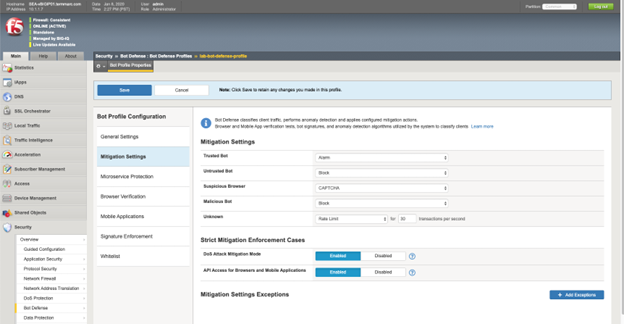
F5 Distributed Cloud Bot Defense detects and stops malicious automation while allowing trusted users and approved AI agents to interact without friction. It protects web apps, mobile apps, and APIs by distinguishing between humans, trusted AI agents, and harmful automation at the application interaction layer.
Detection uses real-time behavioral analysis, client-side intelligence, and platform-wide telemetry, and it identifies automated traffic such as credential stuffing, scraping, and fraud without relying on CAPTCHA. The product adapts continuously as attacker techniques change, applies controls only where abuse occurs, and protects business logic across flows like login, checkout, and account recovery. It can be deployed through the F5 Distributed Cloud Platform, BIG-IP, custom architectures, or public cloud, and integrates with SIEM systems.
Key features include:
- Agent-aware detection: The product identifies and controls AI agents based on their behavior and intent rather than static signatures or identity claims, separating humans, trusted agents, and malicious automation.
- Behavioral analysis and client-side telemetry: Real-time behavioral analysis combined with high-fidelity client-side signals is used to detect human-like bots that go beyond signature-based detection and to resist evasion.
- Continuous adaptation: Defenses adjust automatically as attacker techniques and AI behaviors change, which is intended to reduce the need for constant manual rule tuning.
- Real-time enforcement controls: Controls such as allow, block, rate-limit, or step-up are applied precisely where abuse occurs, so that scrutiny is focused on risky interactions rather than the entire user base.
- Business logic protection: The product detects abuse of application workflows, not just technical exploits, addressing activity that drains inventory, skews analytics, or enables fraud across login, checkout, and account recovery.
- Multiple deployment options: It can be deployed through the F5 Distributed Cloud Platform for WAAP, integrated with BIG-IP through a native module or iApp, deployed in custom on-premises or hybrid architectures, or run close to public cloud workloads using VMs or containers.
- SIEM and platform integration: The product integrates natively with the F5 Application Delivery and Security Platform for shared intelligence and centralized policy, and connects to Syslog and SIEM systems such as Splunk, Devo, Azure Sentinel, Datadog, and SolarWinds.
Limitations (as reported by users on G2):
- Setup complexity: Several reviewers report that the platform is not easy to set up for first-time use and can require significant time or assistance from F5.
- Dated interface: The management interface is described by some as antiquated and text-heavy, with requests for a redesign.
- Pricing: Pricing is repeatedly flagged as higher than some competing bot protection products.
- Latency and opacity: Cloud-hosted inspection can add latency in some scenarios, and a few users find it unclear what the detection algorithms are evaluating.
Source: F5
Specialized Bot Mitigation and Fraud Prevention
5. Akamai Account Protector

Best for: Protecting user accounts across the full lifecycle.
Strengths: Risk scoring from user, device, IP, and network signals.
Things to consider: Configuration is largely managed by the Akamai team.
Akamai Account Protector protects against account abuse across the lifecycle of an account, from account creation through login, password reset, and post-login activity. It uses machine learning together with a dataset of risk and trust indicators to determine the legitimacy of a user request.
The product works through a process of detecting risk from anomalies in user behavior, assessing each request to create a user risk score, responding with block, alert, or allow actions, and updating behavioral profiles from legitimate requests. It recognizes authentic users based on profiles that include devices, networks, locations, and times of activity, evaluates source reputation using activity observed across Akamai customers, and includes bot detections that catch adversarial bots even on a first interaction.
Key features include:
- Behavioral anomaly detection: The product recognizes authentic users from detailed profiles covering devices, networks, locations, and times of activity, and detects anomalies from the first account interaction based on the behavior profile of the entire user population.
- Real-time risk scoring: Each request is assessed for authenticity and assigned a user risk score derived from user, device, IP, and network signals, which then drives the response action.
- Account lifecycle protection: Protection spans the full account lifecycle, including account creation, login, password reset, and post-login activity, rather than focusing on a single point such as login.
- Real-time response actions: Based on the risk score, the product applies customized block, alert, and allow actions at the edge to mitigate high-risk events as they happen.
- Source reputation evaluation: The product evaluates the reputation of a request's source based on past malicious activity observed across all Akamai customers, adding a network-wide signal to its decisions.
- Adversarial bot detection: Bot detections are built to catch and mitigate adversarial bots even on their first interaction, addressing automation that targets account creation and takeover.
- Security analytics integration: The product provides insights that can be fed into fraud investigation platforms and SIEM tools, and its behavioral profiling is updated continuously from legitimate requests.
Limitations (as reported by users on G2):
- Pricing and fees: Reviewers describe the platform as expensive and note onboarding or service fees applied when new products are activated.
- Tuning for false positives: Without careful tuning, users report a need to apply many exceptions to limit false positives across different teams.
- Limited customer control: Some detection thresholds are not visible to customers, and much of the configuration is handled by the Akamai team rather than self-service.
- Manual mitigation for surges: Some users note that large surges in bot traffic may require Akamai involvement rather than being blocked automatically.
- Navigation learning curve: The interface can take new users several weeks to learn.
6. DataDome Bot Protect

Best for: Real-time bot and AI agent defense for sites, apps, APIs.
Strengths: Edge detection under 2ms analyzing every request.
Things to consider: Costs can rise as traffic volume grows.
DataDome Bot Protect protects websites, mobile apps, APIs, and MCP servers from automated threats in real time. It analyzes every request rather than a sample, evaluating hundreds of client-side and server-side signals to assess risk continuously throughout the user journey.
The detection engine processes more than 5 trillion signals per day and uses over 1,000 out-of-the-box and customer-specific models, combined with collective threat intelligence, to distinguish human users, trusted AI agents, and malicious bots. It operates at the edge across more than 35 points of presence with response times under 2 milliseconds, mitigates threats automatically in line with business logic, and includes Agent Trust to validate the identity and intent of AI agents.
Key features include:
- Full request analysis: The product analyzes every request across the user journey, from page visits to logins and cart requests, rather than relying on sampled data, evaluating hundreds of client-side and server-side signals to assess risk.
- AI detection engine: Detection uses more than 1,000 out-of-the-box and customer-specific models alongside collective threat intelligence, processing over 5 trillion signals daily to distinguish human users, trusted AI agents, and malicious bots.
- Edge mitigation across global points of presence: The product operates at the edge across more than 35 points of presence and delivers detection in under 2 milliseconds, so traffic is inspected near users.
- Agent Trust management: Agent Trust identifies, classifies, scores, and governs AI agent traffic, validating the identity and intent of AI agents so that verified agents can interact while malicious automation is blocked.
- Automated mitigation aligned to business logic: High-risk traffic triggers automated responses aligned with business flow, with CAPTCHA available by policy and presented to a very small fraction of requests.
- Threat dashboard and reporting: The dashboard supports endpoint discovery with Watchtower, shows threats by type over time, and allows custom dashboards, saved views, and reports for visibility into bot activity.
- Integrations and data privacy: The product offers more than 80 pre-built integrations across edge CDNs and server-side platforms, and uses two-layer PII encryption intended to exceed standard GDPR and CCPA requirements.
Limitations (as reported by users on G2):
- Cost at scale: The most common feedback is that pricing can become challenging as traffic volume grows, which can be a barrier for smaller teams.
- Setup and integration effort: Initial integration and fine-tuning can take time and often involve developer resources.
- False positives: Strict detection can occasionally affect legitimate users and add friction if it is not carefully tuned.
- Tenant management and data export: Switching between many tenants can be cumbersome, and exporting large volumes of dashboard data is limited.
- Data retention: Some users note that data retention is relatively short for long-term trend analysis.
7. HUMAN Bot Defender

Best for: Behavior-based bot defense for web, mobile, and APIs.
Strengths: Decisioning from 20T weekly signals and 400+ algorithms.
Things to consider: Dashboard retains roughly two weeks of data.
HUMAN Bot Defender, part of the HUMAN Application Protection platform, protects web and mobile applications and APIs against automated attacks. It detects and mitigates malicious traffic from bots, AI agents, and humans across the customer journey to stop fraud, abuse, and misuse.
The platform verifies more than 20 trillion digital interactions weekly across 3 billion unique devices to build its threat telemetry. Its decision engine examines more than 2,500 signals per interaction and connects data to detect anomalies in milliseconds, with signals analyzed by more than 400 algorithms and adaptive machine-learning models. It also provides visibility and control over how bots and AI agents interact with applications, secures client-side scripts, and is backed by the Satori threat research team.
Key features include:
- Behavior-based detection at scale: The platform verifies more than 20 trillion digital interactions weekly across 3 billion unique devices, using this scale to build the threat telemetry behind its bot detection.
- Decision engine signal analysis: The decision engine examines more than 2,500 signals per interaction and connects disparate data to detect anomalies in milliseconds, supporting fast decisions on incoming traffic.
- Algorithmic and machine-learning decisioning: Signals from across the customer journey are analyzed by more than 400 algorithms and adaptive machine-learning models to produce high-fidelity decisions about whether traffic is legitimate.
- Bot, AI, and human traffic classification: The platform detects and mitigates malicious traffic whether it comes from bots, AI agents, or humans, and lets organizations deny unwanted traffic, enable trusted agents and bots, and monetize automated scraping traffic.
- AI agent visibility and governance: Through its agentic capabilities, the platform shows how bots and AI agents interact with applications and governs those interactions, turning agent-mediated activity into managed traffic.
- Client-side script protection: The platform provides visibility and control over browser-side script actions, allowing risky behavior to be blocked without breaking site functionality.
- Satori threat intelligence: The Satori threat research team uncovers, analyzes, and disrupts cyberthreats and fraud schemes, and the platform includes features such as HUMAN Challenge, Precheck, and Threat Tracker.
Limitations (as reported by users on G2):
- Dashboard usability: Reviewers note the administration dashboard can be difficult to navigate, with a learning curve in finding settings and environments.
- Data retention and reporting: The dashboard retains roughly two weeks of data, and some users want more detailed reporting and easier access to historical trends.
- Dashboard performance: Some users report that dashboards can be slow to load or time out, including when searching by route.
- Pricing transparency: Several reviewers describe the pricing model as opaque and would prefer clearer published pricing.
- CAPTCHA friction and false positives: Occasional duplicate CAPTCHAs and false positives are reported when detection is not fully tuned.
まとめ
Anti-bot software has become a critical component of modern application security strategies. As automated attacks become more sophisticated, organizations increasingly rely on machine learning, behavioral analytics, and global threat intelligence to distinguish between legitimate users and malicious bots. Effective solutions combine real-time detection, flexible mitigation controls, and detailed analytics to reduce fraud, protect digital assets, and maintain application availability while minimizing disruption for legitimate users.