Summary: DDoS protection defends services against traffic floods that cause downtime. Best picks: Radware for behavioral multi-layer defense, Cloudflare for web-scale capacity, Akamai Prolexic for enterprise scale, and Imperva for fast mitigation SLAs.
What is DDoS Protection?
DDoS protection refers to the strategies used to protect servers and networks from distributed denial of service (DDoS) attacks. These attacks aim to make online services unavailable by overwhelming them with excessive traffic from multiple sources. DDoS protection is crucial for maintaining uptime and ensuring services are accessible to legitimate users.
Implementing DDoS protection involves various measures, including identifying legitimate and malicious traffic. It helps mitigate the impact of attacks, ensuring business continuity. Companies often use specialized tools and services to detect and mitigate attacks before they impact service performance.
Editor's note: This article has been updated to cover recent market trends and current information about tools to reflect features and capabilities in 2026.
This is part of an extensive series of guides about information security.
In this article:
The table below summarizes the key differences between the DDoS protection solutions covered in this guide. We explore each solution in more detail in the sections that follow.
| Category |
ソリューション |
Best For |
Key Strengths |
Things to Consider |
| Cloud-Based |
ラドウェア |
Behavioral multi-layer cloud DDoS |
Automatic real-time signatures; 30 Tbps network |
Setup can be complex; limited docs |
| Cloud-Based |
Cloudflare |
Web, network and TCP/UDP protection |
500 Tbps; integrated WAF, CDN, bot tools |
Steep learning curve for advanced setup |
| Cloud-Based |
Akamai Prolexic |
High-capacity managed enterprise DDoS |
20+ Tbps dedicated; zero-second SLA |
Premium cost; limited self-service |
| Cloud-Based |
AWS Shield |
Applications hosted within AWS |
Automatic L3/4/7 mitigation; AWS threat intel |
AWS-only scope; cost |
| Cloud-Based |
Azure DDoS Protection |
Applications in Azure virtual networks |
Always-on; adaptive tuning; cost protection |
Limited reporting and dashboard insight |
| On-Premises/Hybrid |
FortiDDoS |
Inline hardware mitigation at the edge |
Autonomous; 100% packet inspection under 1s |
Interface/reporting; cloud complexity |
| On-Premises/Hybrid |
F5 |
Cloud-delivered network and app mitigation |
Multi-terabit L3-L7; managed SOC |
Premium cost; occasional false positives |
| On-Premises/Hybrid |
NETSCOUT Arbor |
On-prem detection for SPs and enterprises |
Stateless inline; ATLAS threat intelligence |
Tuning effort; configuration complexity |
| On-Premises/Hybrid |
Imperva |
Always-on web, network and IP protection |
3-second L3/4 SLA; automated mitigation |
Pricing; regional latency |
Market Size and Growth Forecast
The global DDoS protection market is expanding steadily. It is valued at USD 4.73 billion and expected to grow to USD 10.28 billion, reflecting a compound annual growth rate (CAGR) of 13.83%. This growth is driven by the increasing scale and complexity of attacks, including multi-vector and terabit-scale incidents. Regulatory requirements and the shift toward cloud and hybrid mitigation models are also contributing to sustained demand.
Market Segmentation Insights
By component, solution-based offerings dominate the market. Solutions account for more than 60% of revenue, showing strong enterprise demand for integrated and programmable defenses. Advanced bot mitigation is one of the fastest-growing areas, with a projected CAGR above 15% through 2031.
In terms of deployment, cloud-based solutions hold nearly half of the market share. However, hybrid deployments are growing faster, as organizations combine on-premises controls with cloud-scale scrubbing to balance latency, compliance, and operational flexibility.
Regional Trends
North America remains the largest regional market, accounting for roughly 39% of revenue. The region's position is supported by strong regulatory frameworks and high-value digital infrastructure.
Asia Pacific is the fastest-growing region, with a CAGR of approximately 14–15% through 2031. Growth is linked to rapid 5G deployment, expanding IoT ecosystems, and accelerating digital transformation. Other regions, including Europe, are influenced by stricter cybersecurity regulations that require demonstrable resilience against large-scale attacks.
Key Market Drivers and Restraints
Several factors are accelerating market growth. The rise in multi-vector and high-bandwidth attacks is pushing organizations to adopt adaptive and AI-driven mitigation platforms. The expansion of IoT, 5G, and edge-connected devices is increasing the number of endpoints that can be exploited for botnets. In addition, cloud and hybrid mitigation models are becoming standard due to their scalability and flexibility.
However, certain restraints remain. The high total cost of ownership for on-premises hardware limits adoption among smaller organizations. A global shortage of cybersecurity professionals is also slowing deployment and management. Encrypted attack traffic reduces visibility, and overly aggressive mitigation policies can lead to false positives and unintended service disruption.
DDoS protection tools are specialized solutions to detect, prevent, and mitigate the impact of DDoS attacks on networks, servers, and applications. They use various techniques to monitor traffic, block malicious requests, and ensure that legitimate traffic is not affected during an attack.
The main objective is to help organizations maintain service availability and prevent downtime caused by DDoS attacks. Some DDoS protection tools operate as cloud-based services, integrating with an organization's existing infrastructure to provide scalable protection. These solutions can handle massive traffic surges by distributing incoming traffic across global networks or scrubbing it through filtering systems. Other tools are deployed on-premises, allowing customization and closer integration with an organization's cybersecurity ecosystem.
Related content:
DDoS protection tools typically include some or all of the following capabilities:
Traffic Analysis and Filtering
Traffic analysis and filtering techniques involve monitoring network traffic to identify and separate legitimate requests from malicious ones. By analyzing traffic patterns, tools can detect anomalies that indicate a potential DDoS attack, triggering filters to block malicious traffic.
Filtering works in real time, ensuring minimal impact on legitimate traffic. Traffic analysis aids in immediate threat mitigation and helps in understanding attack trends, informing future protection strategies.
Geolocation Filtering
Geolocation filtering involves blocking or restricting traffic based on geographic origin. This method limits access from regions known for high malicious activity levels, reducing potential DDoS attack vectors. Geolocation filtering is configured based on historical data and threat intelligence.
Volumetric DDoS Protection
Volumetric DDoS protection focuses on mitigating attacks that aim to overwhelm network bandwidth by sending massive amounts of traffic to the target system. These attacks, often referred to as 'flood' attacks, use techniques like UDP floods, ICMP floods, and DNS amplification to saturate the available network resources, rendering services inaccessible.
To counter these attacks, volumetric DDoS protection tools use high-capacity mitigation infrastructure capable of absorbing and dispersing the attack traffic. This often includes cloud-based solutions that handle large-scale traffic and reroute it through distributed networks.
Protocol-Based DDoS Protection
Protocol-based DDoS protection addresses attacks that exploit vulnerabilities in communication protocols such as TCP, UDP, and ICMP. Common types of protocol-based attacks include SYN floods and Smurf attacks, which exploit weaknesses in how systems handle network requests to exhaust server resources.
Mitigation of protocol-based attacks involves inspecting network traffic at the protocol level, identifying abnormal packet structures, connection attempts, or malformed requests. Tools often use SYN cookies and connection rate limiting to prevent server exhaustion.
Traffic Scrubbing
Traffic scrubbing involves redirecting traffic through networks capable of handling very high capacity and removing malicious packets. This process treats and cleans incoming requests before they reach the target server. Scrubbing centers use filtering mechanisms to ensure only legitimate traffic is allowed through.
Application Layer DDoS Protection
Application layer DDoS protection targets attacks that focus on the application layer (Layer 7) of the OSI model, where attackers exploit web application functions such as HTTP, DNS, or SSL. These attacks are more difficult to detect because they mimic legitimate user behavior, overwhelming the application server with seemingly valid requests.
Application layer protection involves deep packet inspection and behavioral analysis to differentiate between normal and malicious traffic. Advanced algorithms monitor patterns such as request rates and user interaction behaviors, flagging unusual activities that signal an attack.
Behavioral-Based Mitigation
Behavioral-based mitigation focuses on identifying deviations from normal traffic patterns to detect and block DDoS attacks. By using machine learning and behavioral algorithms, advanced DDoS protection tools learn what typical user behavior looks like and distinguish between legitimate and malicious activities.
Once abnormal behavior is detected, such as unusual request patterns or irregular data flows, the system automatically triggers protective measures to block potential threats. This approach reduces the risk of false positives, ensuring legitimate users aren't affected by the mitigation efforts.
Rate-Based Mitigation
Rate-based mitigation limits the traffic rate to prevent overwhelming a system. By setting thresholds for data requests, this technique controls high-volume surges typical in DDoS attacks. It's applied across different protocol layers to prevent server overload.
Learn more in our detailed guide to DDoS mitigation.
DDoS protection tools can be hosted on-premises or in the cloud.
Cloud-Based DDoS Protection
Cloud-based DDoS protection offers scalable solutions by leveraging cloud infrastructure, diverting malicious traffic away from on-premise systems. These services detect, analyze, and block attacks remotely, reducing the operational impact on the target.
This model provides flexibility, allowing organizations to scale protection based on demand. Offsite protection ensures network infrastructure remains secure and accessible, enabling consistent performance during persistent DDoS threats.
On-Premises DDoS Protection
On-premises DDoS protection uses hardware devices installed within a company's network to monitor and mitigate attacks. These systems provide more control over security settings, allowing tailored protection strategies.
The proximity of on-premises solutions offers real-time attack remediation and integration with existing network infrastructure. These systems provide visibility into traffic patterns and customizable rules, suitable for organizations requiring internal control over their security measures.
Learn more in our detailed guide to DDoS protection services.
How we selected these tools: We shortlisted DDoS protection solutions based on the breadth of attack coverage across network and application layers, mitigation capacity and speed, deployment flexibility across cloud, on-premises, and hybrid environments, and the level of automated detection and managed support each vendor provides.
Cloud-Based DDoS Protection Solutions
1. Radware
Best for: Behavioral, multi-layer cloud DDoS protection at scale
Strengths: Behavioral detection with automatic real-time signatures
Things to consider: Initial setup can be complex with limited documentation
Radware Cloud DDoS Protection Service uses behavioral algorithms to detect and mitigate DDoS attacks across both network and application layers. Its Infrastructure DDoS Protection handles network-layer (L3/4) volumetric floods such as SYN, ICMP, and UDP floods, and defends DNS infrastructure against query floods, amplification attacks, and randomized subdomain (water torture) attacks.
An optional Cloud Web DDoS Protection add-on adds Layer 7 behavioral detection that blocks HTTP/S floods and Web DDoS Tsunami attacks, creating attack signatures automatically to keep pace with randomized traffic. The service runs from a global network of 25 scrubbing centers providing 30 Tbps of mitigation capacity, connected in full mesh using Anycast routing, and is available in on-demand, always-on, and hybrid deployment models backed by Radware's Emergency Response Team.
Key features include:
- Behavioral detection and automatic signatures: The service profiles normal traffic and uses behavioral algorithms to identify deviations, then generates attack signatures automatically in real time. This allows it to block network-layer, application-layer, zero-day, and encrypted attacks without relying on predefined rules.
- Infrastructure (Layer 3/4) protection: It absorbs volumetric network floods such as SYN, ICMP, and UDP floods and protects DNS infrastructure against query floods, amplification, and randomized subdomain (water torture) attacks. This covers the network-layer assaults that aim to saturate bandwidth and exhaust resources.
- Web DDoS (Layer 7) protection add-on: With or without certificate sharing, the Cloud Web DDoS Protection layer detects and mitigates sophisticated HTTP/S floods and Web DDoS Tsunami attacks. It uses behavioral analysis and automatic Layer 7 signature creation to handle randomized application-layer traffic.
- Flexible deployment models: Protection can run on-demand, with traffic diverted only during volumetric attacks; always-on, with all traffic continuously routed through scrubbing centers; or hybrid, integrated with an on-premises device for real-time on-site mitigation with cloud backup for large attacks.
- Global scrubbing network: A worldwide network of 25 scrubbing centers with 30 Tbps of capacity is connected in full mesh using Anycast routing. This distributes the attack load and mitigates traffic near its point of origin to absorb large volumetric attacks.
- Managed service and management system: The service is fully managed by Radware's Emergency Response Team and includes an attack-centric Cloud DDoS Management System. Users can drill down into current and historical attack data per asset for analysis during and after incidents.
- Add-on services: Firewall-as-a-Service provides a cloud network-layer firewall to block unwanted IPs and geographies before they reach the network, and Network Analytics gives granular insight into network traffic and the services in use.
Limitations (as reported by users on G2):
- Initial configuration effort: Some users note that initial setup and onboarding can be involved and may benefit from vendor assistance to complete.
- Documentation depth: Reviewers mention that available product documentation could be more detailed to support self-service configuration.
- Pricing structure: A few users find that the user-based pricing model can become costly as the number of protected assets grows.
2. Cloudflare

Best for: Always-on web, network, and TCP/UDP DDoS protection
Strengths: 500 Tbps network with integrated WAF, CDN, and bot tools
Things to consider: Advanced configuration has a steep learning curve
Cloudflare provides DDoS protection through a globally distributed network that filters malicious traffic before it reaches an organization's infrastructure. The platform protects websites and web applications, TCP/UDP services, and entire networks across OSI layers 3, 4, and 7.
Rather than routing traffic to centralized scrubbing facilities, Cloudflare mitigates attacks at data centers distributed worldwide, on the same infrastructure that serves a large share of internet traffic. Its network has 500 Tbps of capacity, which it uses to absorb large volumetric attacks without degrading performance. Protection is enabled through a dashboard or API and is supported around the clock, including an Under Attack hotline for active incidents.
Key features include:
- High-capacity global network: Cloudflare operates a network with 500 Tbps of capacity that absorbs and mitigates large-scale volumetric DDoS attacks. Protected websites, applications, and networks stay online and fast even during very large attacks.
- Website and application protection: HTTP/S DDoS attacks targeting websites, APIs, and applications are filtered at the network edge. Legitimate requests continue to be served during an attack without manual intervention.
- TCP/UDP and custom protocol protection: Cloudflare Spectrum extends DDoS mitigation to applications built on any TCP or UDP protocol, including custom protocols. It protects boxes, containers, and virtual machines that rely on non-HTTP services.
- Network and infrastructure defense: Magic Transit protects networks, data centers, and infrastructure against Layer 3 and 4 attacks. Network traffic is routed through Cloudflare's global network so attacks are filtered before reaching on-premises equipment.
- Rapid activation and 24/7 support: Protection can be turned on through the dashboard or API for quick onboarding. Cloudflare provides 24/7 email and phone support and an Under Attack hotline for immediate assistance during incidents.
- Integration with adjacent services: DDoS protection runs alongside Cloudflare's web application firewall, bot management, CDN, load balancing, rate limiting, and SSL. This lets security and performance controls be configured and managed together.
Limitations (as reported by users on G2):
- Learning curve for advanced setup: Users report that custom WAF rules, firewall tuning, and routing options require networking knowledge and can be challenging for newcomers.
- Support tied to plan tier: Some reviewers note that faster support and direct assistance during attacks are associated with higher-tier paid plans.
- Feature gating across tiers: Several users mention that certain advanced security and performance capabilities are available only on higher-priced plans.
3. Akamai Prolexic

Best for: Large enterprises needing high-capacity managed DDoS
Strengths: 20+ Tbps dedicated capacity with zero-second mitigation SLA
Things to consider: Premium pricing and limited self-service controls
Akamai Prolexic is a DDoS protection platform available as a cloud service, an on-premises solution (powered by Corero), or a hybrid of both, and it can run always-on or on-demand. Incoming traffic is routed to Prolexic, which inspects it, applies proactive or custom mitigation controls, separates attack traffic from legitimate traffic, and delivers only clean traffic to the customer's systems.
The platform provides more than 20 Tbps of dedicated DDoS defense capacity across 32 anycast scrubbing centers, backed by Akamai's broader network. Mitigation is managed by a 24/7/365 security operations command center staffed by frontline responders who handle attacks before, during, and after they occur. Prolexic protects IPv4 and IPv6 traffic and can be combined with a network cloud firewall for additional edge filtering.
Key features include:
- Multi-environment deployment: Prolexic can be deployed in-cloud, on-premises (powered by Corero), or as a hybrid. It operates in always-on mode, with all inbound traffic routed through Prolexic, or on-demand mode, with traffic routed only during an attack.
- Dedicated defense capacity: The platform provides more than 20 Tbps of dedicated DDoS defense across 32 anycast scrubbing centers. Anycast routing mitigates attacks closest to their source while pooling global capacity for the largest attacks.
- Proactive and custom mitigation controls: Traffic is inspected and filtered using proactive controls and customer-specific rules. Attack traffic is separated from valid traffic to prevent overload across both IPv4 and IPv6 flows.
- Managed SOCC service: A 24/7/365 security operations command center with frontline responders across six global locations provides pre-, during-, and post-attack review and analysis. This is delivered as part of the fully managed service.
- Prolexic Network Cloud Firewall: A cloud firewall sits at the network edge, outside other firewalls. Customers define geographic and IP-based access control lists, or have Akamai suggest them, with API-driven integration and centralized control for zero-day response.
- Flexible connectivity options: Routed GRE delivery is available for advertisable network blocks, IP Protect provides anycast routing for smaller or fragmented IP space, and Prolexic over Akamai Direct Connect offers private, high-capacity connectivity.
Limitations (as reported by users on G2):
- Premium cost: Reviewers describe the monthly subscription as comparatively high relative to other providers.
- Limited self-service automation: Some users note the absence of certain automated mitigation controls, such as auto-throttling, that they would prefer to manage themselves.
- Visibility constraints: Because much of the mitigation is handled by Akamai's operations center, some users report limited logging and direct control over their own traffic.
4. AWS Shield

Best for: Protecting applications hosted within the AWS ecosystem
Strengths: Automatic inline L3/4/7 mitigation with AWS threat intel
Things to consider: Protection is limited to AWS-hosted resources
AWS Shield protects networks and applications by identifying network security configuration issues and defending applications against web exploitation and DDoS events. It offers two capabilities: AWS Shield network security director, which analyzes resources to visualize network topology, surface configuration issues, and recommend remediations; and AWS Shield Advanced, which provides managed, continuous, automatic mitigation of DDoS events.
Shield Advanced delivers automatic inline mitigation across OSI layers 3, 4, and 7 using AWS global threat intelligence, and baselines normal application traffic to detect anomalies such as HTTP floods and DNS query floods. Protection can be customized with application-specific security controls, the Shield Response Team is available during active incidents, and the service integrates with AWS WAF for request filtering and rate-based rules.
Key features include:
- Managed automatic DDoS mitigation: Shield Advanced applies automatic inline mitigation that detects and blocks DDoS events across layers 3, 4, and 7 without manual intervention. This reduces the operational load on security teams during attacks.
- AWS global threat intelligence: Mitigation draws on AWS-wide threat intelligence to recognize and block evolving attack patterns. Protected applications are defended against known malicious sources and emerging threats.
- Traffic baselining and anomaly detection: The service automatically baselines normal application traffic and detects anomalies such as HTTP floods and DNS query floods. Defenses adapt to each application's specific behavior over time.
- Network-layer scrubbing controls: Inline mitigations such as deterministic packet filtering and priority-based traffic shaping stop network-layer attacks. These include SYN floods, UDP floods, and reflection attacks aimed at specific layers.
- Network security director: A capability in preview assesses AWS resources, visualizes network topology, prioritizes misconfigured resources, and provides remediation recommendations. Natural-language queries are available through Amazon Q Developer.
- Shield Response Team and WAF integration: Customers can engage the Shield Response Team during incidents. AWS WAF rate-based rules and request validation can be applied to block HTTP floods and abnormal traffic patterns.
Limitations (as reported by users on G2):
- Cost barrier: Reviewers note that Shield Advanced carries a significant monthly subscription fee plus data transfer charges, which can be steep for smaller organizations.
- AWS-only scope: Users point out that protection covers resources within the AWS ecosystem and does not extend to hybrid or multi-cloud environments.
- Configuration complexity: Some reviewers report that the service is difficult to manage and that changes are hard to implement if protection was not engineered upfront.
5. Azure DDoS Protection
Best for: Protecting applications running in Azure virtual networks
Strengths: Always-on monitoring with adaptive tuning and cost protection
Things to consider: Reporting and dashboard insight are limited
Azure DDoS Protection is a cloud service that defends applications deployed in Azure virtual networks against distributed denial-of-service attacks. It applies always-on traffic monitoring and automatically mitigates attacks when abnormal traffic is detected, using adaptive tuning that compares live traffic against thresholds defined in a DDoS policy.
The service defends against network-layer (Layer 3/4) attacks and, combined with a web application firewall, common application-layer (Layer 7) attacks. It integrates with Azure Monitor, Microsoft Defender for Cloud, and Microsoft Sentinel for alerting and telemetry, and a rapid response team is available during active attacks under a 15-minute SLA. It is offered as Network Protection and IP Protection tiers and is zone-resilient by default.
Key features include:
- Always-on monitoring and automatic mitigation: Traffic is continuously monitored for attack patterns, and mitigation is triggered automatically when abnormal traffic is detected. No changes to the protected applications are required to enable it.
- Adaptive real-time tuning: Machine learning-based traffic profiling learns each application's normal patterns. It adjusts the mitigation thresholds defined in the DDoS policy as application usage changes over time.
- Multilayer protection: The service mitigates network-layer (Layer 3 and 4) attacks. When combined with a web application firewall such as Application Gateway WAF, it extends protection to application-layer (Layer 7) attacks.
- Edge scrubbing capacity: Attack traffic is scrubbed using large mitigation capacity at the network edge before it reaches applications. This helps maintain availability during volumetric attacks.
- Telemetry and rapid response: Attack metrics and reports integrate with Azure Monitor, Microsoft Defender for Cloud, and Microsoft Sentinel. A DDoS rapid response team is available during attacks under a 15-minute SLA.
- Tiered options and cost protection: Network Protection and IP Protection tiers match different needs. The service also helps offset DDoS-related cost spikes such as application scaling charges and bandwidth surges.
Limitations (as reported by users on G2):
- Subscription cost: Reviewers note the monthly cost of the standard tier and the absence of a trial before committing.
- Reporting and dashboard depth: Some users find the dashboard short on insight and reporting, with much of the data routed to separate logging workspaces.
- Configuration and support: Several reviewers describe configuration as not straightforward and report variable support response times.
On-Premises/Hybrid DDoS Protection Solutions
6. FortiDDoS

Best for: Inline, hardware-based DDoS mitigation at the network edge
Strengths: Autonomous mitigation with 100% packet inspection under 1s
Things to consider: Interface and reporting could be more refined
FortiDDoS is an inline, purpose-built appliance that protects networks and applications against attacks that flood a target with packets and exhaust resources. Deployed in line within the network, it automatically detects and stops multiple simultaneous attacks of any size without user intervention or additional subscriptions.
The platform monitors around 230,000 parameters simultaneously to identify abnormal behavior and zero-day attacks, and inspects 100% of packets rather than sampling, completing mitigations in under one second. It uses behavior-based detection with hardware security processing units and is available as hardware appliances ranging from entry level to high capacity, as well as virtual machines. FortiDDoS provides Layer 3, 4, and 7 mitigation and is supported by FortiGuard threat intelligence services.
Key features include:
- Fully autonomous mitigation: The appliance detects and stops multiple simultaneous attacks of any size without user intervention during attacks. No additional subscriptions are required for it to operate.
- Extensive parameter monitoring: Around 230,000 parameters are monitored simultaneously to detect abnormal traffic patterns. This breadth of monitoring is used to identify zero-day attacks across the protected network.
- Full packet inspection: All traffic packets are inspected rather than sampled, with high small-packet inspection capacity of up to 77 million packets per second. Mitigation is completed in under one second from the first packet.
- Layer 4 and Layer 7 attack coverage: Protection covers TCP flag, DNS, NTP, DTLS, and QUIC attacks, including direct and reflected variants. More than 10,000 UDP reflection ports are monitored to detect amplification attacks.
- Hardware and virtual deployment: FortiDDoS is offered as hardware appliances spanning entry-level to high-capacity models and as virtual machines. Appliances provide high availability and optical bypass options for network continuity.
- FortiGuard security services: FortiGuard domain reputation and anti-botnet and command-and-control services supply updated intelligence. These help block DNS-based attacks and communication with compromised remote servers.
Limitations (as reported by users on G2):
- Interface and reporting: Users note that the web interface and reporting capabilities could be improved and made more user-friendly.
- Complexity in cloud environments: Reviewers report added complexity when extending protection into distributed and cloud environments.
- Cost and capacity: Some users find pricing high relative to alternatives and note on-premises capacity limits on appliances.
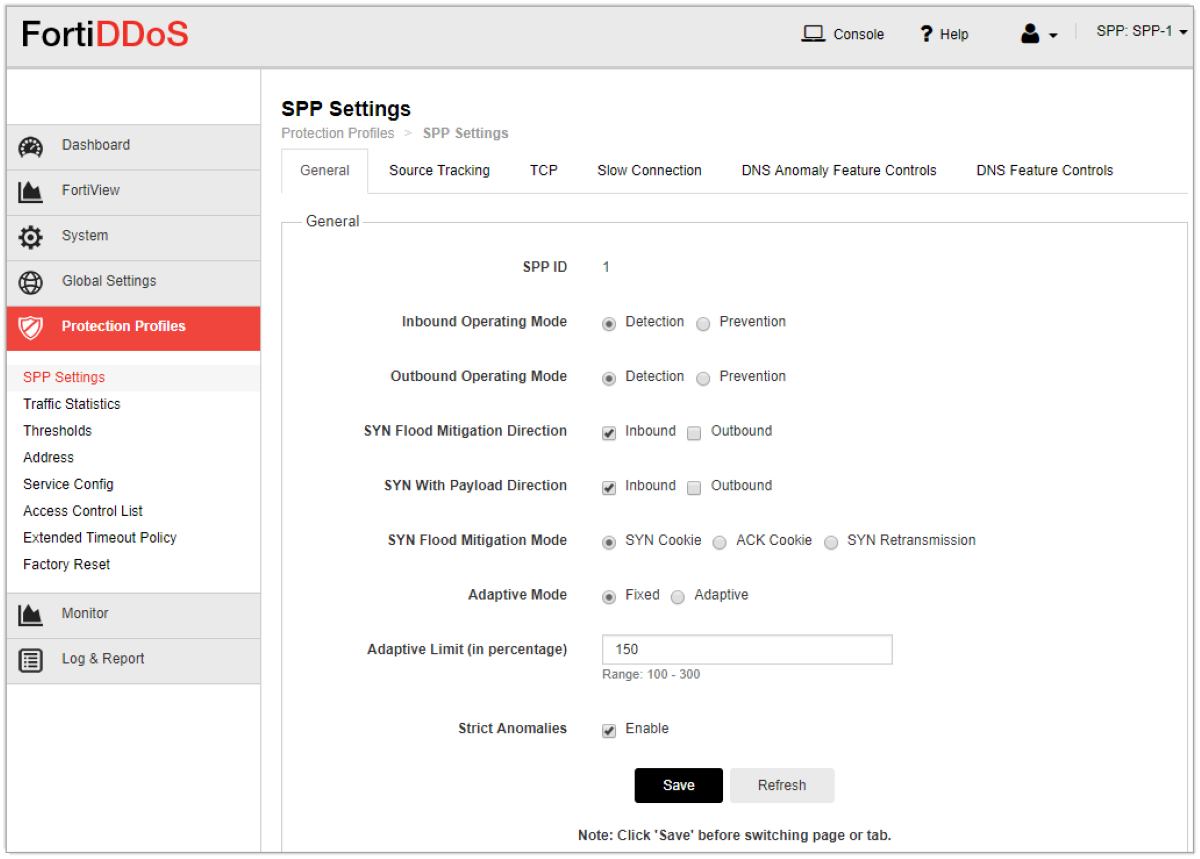
Source: Fortinet
7. F5

Best for: Cloud-delivered mitigation for networks and applications
Strengths: Multi-terabit L3-L7 scrubbing with managed SOC support
Things to consider: Premium cost and occasional false positives
F5 Distributed Cloud DDoS Mitigation is a managed, cloud-delivered service that detects and mitigates attacks before they reach an organization's network infrastructure and applications. It defends against Layer 3 to Layer 7 attacks, including large-scale network, SSL, and application-targeted attacks that can exceed hundreds of gigabits per second, using the F5 Global Network and the F5 Security Operations Center.
The service is offered as an Always On subscription that continuously routes and filters traffic, or an Always Available subscription that runs on standby and is activated during an attack. It scrubs volumetric Layer 3-4 attacks, mitigates Layer 7 attacks such as HTTP floods and slowloris, and stops DNS floods, reflection, and amplification. A centralized console and an AI assistant support analysis and reporting.
Key features include:
- Volumetric Layer 3-4 protection: Multi-terabit ingest capacity scrubs network-level and signature-based attacks such as TCP, SYN, teardrop, and smurf attacks. Traffic is cleaned before it reaches enterprise infrastructure.
- Application Layer 7 mitigation: The service mitigates application attacks, including HTTP floods and slowloris attacks. These target the application layer to consume resources and degrade application performance.
- DNS attack protection: It recognizes and stops DNS floods, reflection, and amplification attacks. This protects name resolution services that attackers use to amplify traffic.
- Always On and Always Available models: An Always On subscription continuously routes and filters traffic through the platform. An Always Available subscription stays on standby and is initiated when an attack occurs.
- Managed service and SLAs: Deployment, maintenance, and 24/7 support are handled by certified F5 experts in the SOC, with a 99.99% uptime SLA. A centralized console provides attack visibility before, during, and after incidents.
- Broad integration and automation: The service supports applications on any public or private cloud and on VMs, containers, bare metal, or serverless. It offers service discovery, SIEM, and automation integrations, plus an AI assistant for natural-language analysis.
Limitations (as reported by users on Gartner Peer Insights):
- Occasional false positives: Reviewers note that legitimate traffic is sometimes blocked during mitigation.
- Premium cost: Several users describe the service as expensive relative to alternatives.
- Cross-product integration: Some users report challenges integrating with other F5 products, such as on-premises web application firewalls.
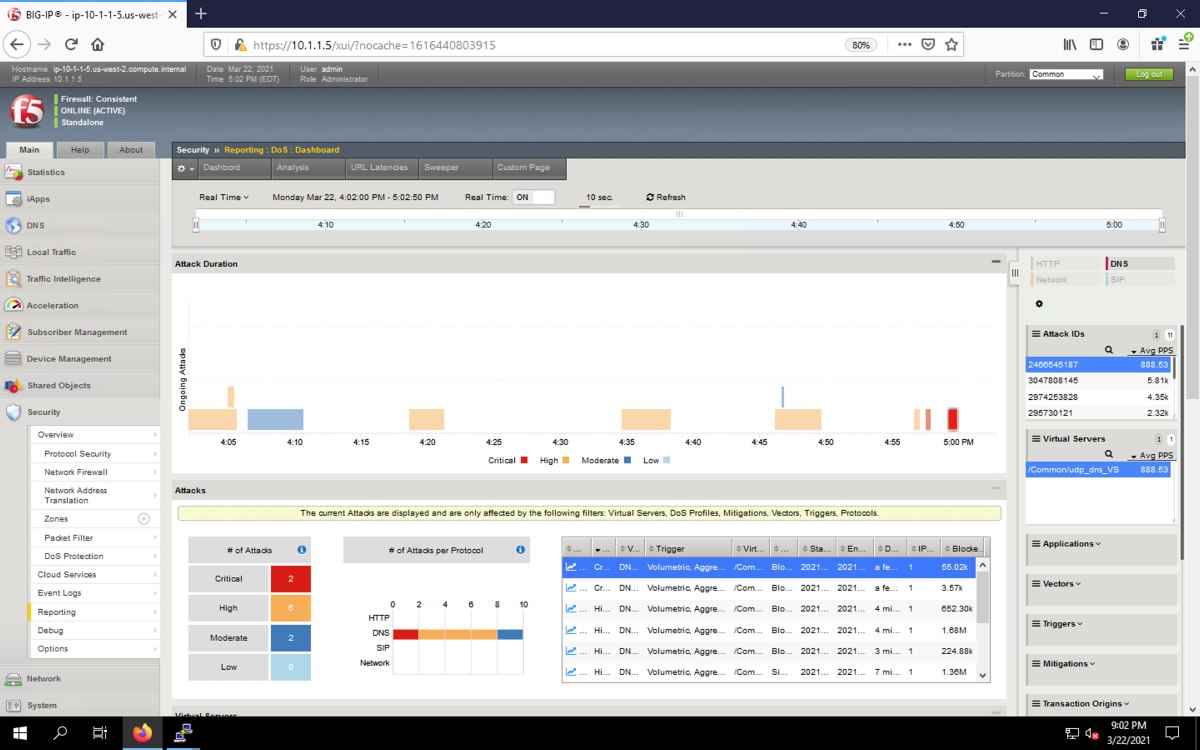
Source: F5
8. NETSCOUT Arbor

Best for: Service providers and enterprises needing on-prem detection
Strengths: Stateless inline detection backed by ATLAS threat intel
Things to consider: Tuning and management require significant effort
NETSCOUT Arbor provides DDoS detection and defense products that have protected internet availability for more than 25 years, with visibility into a large share of global internet traffic through its ATLAS intelligence system. Its Arbor Edge Defense appliance is an inline security device deployed at the network perimeter, between the internet router and firewall, providing stateless, on-premises DDoS protection driven by AI and machine learning.
The portfolio pairs local network visibility with global threat intelligence to deliver automated detection of dynamic, multi-vector attacks and intelligently orchestrated mitigation. Beyond the on-premises appliance, Arbor offers Sightline for network-wide visibility, the Threat Mitigation System for large-scale scrubbing, and Arbor Cloud for cloud-based mitigation. Solutions can be deployed as managed services, in-cloud, on-premises, or virtualized.
Key features include:
- Arbor Edge Defense appliance: An inline, stateless security appliance is deployed between the internet router and firewall. It provides on-premises detection and mitigation of inbound application-layer and state-exhaustion attacks using AI and machine learning.
- ATLAS and ASERT threat intelligence: Arbor products are backed by NETSCOUT's ATLAS global attack visibility system and ASERT research team. These supply continuously updated intelligence used to recognize current attack methods.
- Automated multi-vector detection: The platform automatically detects dynamic, multi-vector DDoS attacks. It combines local network visibility with global intelligence for comprehensive coverage of attack types.
- Intelligently orchestrated mitigation: Multiple mitigation methods are orchestrated automatically using transparent AI. The Arbor Threat Mitigation System filters malicious traffic while allowing legitimate traffic to pass at scale.
- Network visibility products: Arbor Sightline monitors and identifies network and security issues at scale, Arbor Insight adds traffic analytics, and Sightline with Sentinel automates DDoS incident response to simplify operations.
- Hybrid and cloud options: Arbor Cloud provides cloud-based scrubbing across global scrubbing centers, and managed services offer 24/7 expert handling. On-premises and cloud mitigation can be combined for layered protection.
Limitations (as reported by users on G2):
- Manual tuning effort: Reviewers note that the system requires considerable manual fine-tuning to reach expected results.
- Configuration complexity: Some users describe it as complex to configure and manage effectively.
- Cost and scope: Several users report that licensing and support can be costly for smaller organizations, and that the products focus on DDoS, leaving other threats less covered.
9. Imperva

Best for: Always-on protection for websites, networks, and IPs
Strengths: Three-second L3/4 mitigation SLA with automated defense
Things to consider: Pricing and regional latency raised by some users
Imperva DDoS Protection defends against volumetric, protocol-based, and application-layer attacks with a guaranteed three-second mitigation SLA for Layer 3 and 4 attacks. It is offered in three forms: Website Protection routes HTTP/S traffic through a secure proxy via a DNS change to filter application-layer attacks and mask the origin server; Networks Protection uses multi-terabit scrubbing to defend entire network ranges, typically mitigating within one second; and Individual IP Protection safeguards specific IP addresses, including non-HTTP assets.
The service runs on a global Anycast network where most of the world experiences low latency, and it is ISP-agnostic. Protection can operate always-on or on-demand, with automated mitigation, machine learning to limit false positives, and integration with the broader Imperva Application Security platform.
Key features include:
- Three-second mitigation SLA: Imperva guarantees mitigation of Layer 3 and 4 attacks within three seconds. Network-range attacks are typically mitigated within one second using multi-terabit scrubbing capacity.
- Website protection with WAF: HTTP/S traffic is routed through a secure proxy via a DNS change, masking the origin server's IP address. Application-layer DDoS traffic is filtered alongside Imperva's cloud web application firewall.
- Network and individual IP protection: Networks Protection defends entire infrastructures against Layer 3 and 4 volumetric and multi-vector attacks with flexible GRE tunnel and cross-connect options. Individual IP Protection covers specific IPs, including non-HTTP assets.
- Global Anycast network: An ISP-agnostic global network uses Anycast routing and real-time capacity management. This keeps latency low for most of the world while filtering attack traffic across efficient paths.
- Automated mitigation and low false positives: Once configured, the platform automatically detects and blocks attacks without manual intervention. Machine learning, behavioral, and contextual analysis mean only a small fraction of visitors encounter CAPTCHA challenges.
- Coverage of varied attack types: The service mitigates Layer 3/4 attacks such as UDP floods, SYN floods, and DNS amplification, and Layer 7 attacks such as HTTP GET/POST floods and slowloris. Notifications are delivered via email, SMS, and a mobile app, with SIEM integration.
Limitations (as reported by users on G2):
- Pricing: Reviewers note that cost can be a concern, particularly for larger enterprises.
- Regional latency: Some users in under-served regions report added latency where traffic must travel to distant points of presence.
- Reporting and interface: Several users would like a more modern interface, improved reporting transparency, and more flexible logging.
まとめ
DDoS protection is essential for protecting online services and ensuring their availability during attacks. By using a combination of traffic analysis, filtering, and mitigation techniques, organizations can detect and block malicious traffic without disrupting legitimate user access. These protection strategies help maintain business continuity, minimize downtime, and protect critical infrastructure from the growing threat of DDoS attacks.
See Additional Guides on Key Information Security Topics
Together with our content partners, we have authored in-depth guides on several other topics that can also be useful as you explore the world of information security.
ボット保護
Authored by Radware