Summary: Application delivery solutions blend load balancing, security, and performance optimization to keep apps fast and available. Top picks: Radware for unified delivery and security, F5 and NetScaler for broad platforms, and Kemp LoadMaster for value.
What Are Application Delivery Solutions?
Application delivery solutions are technology suites that ensure fast, secure, reliable access to apps for users. They handle everything from traffic distribution to securing the app edge, ensuring a great user experience and compliance.
Key components and functions of application delivery solutions include:
- Load balancing: Distributes traffic across multiple servers to prevent overload (e.g., round-robin, policy-based).
- Security: Protects apps with Web Application Firewalls (WAF), DDoS mitigation, and identity controls (SSO, MFA).
- Performance: Caching, TLS offloading, and global routing speed up delivery.
- Access control: Manages who can access what, often via secure gateways or portals.
- Traffic management: Intelligent routing based on health, location, or policies.
- Content Delivery Networks (CDNs): Enables faster content delivery through a distributed network.
- Zero trust enforcement: Ensures security by assuming the system is breached and restricting access accordingly.
This is part of a series of articles about application performance.
In this article:
The table below summarizes the key differences between the application delivery solutions covered in this article. We explore each of them in more detail in the sections that follow.
| Category |
ソリューション |
Best For |
Key Strengths |
Things to Consider |
| Integrated Application Delivery and Security Platforms |
Radware (Alteon) |
Unified delivery and security across any cloud |
Single ADC architecture; cloud-augmented security |
Advanced tuning needs specialist skills |
| Integrated Application Delivery and Security Platforms |
F5 Application Delivery and Security Platform |
Converging delivery and security in one platform |
Unified platform; any form factor |
Interface can feel dated; complex troubleshooting |
| Integrated Application Delivery and Security Platforms |
Fortinet FortiADC |
Security Fabric users wanting ADC plus security |
All-in-one ADC, WAF and security; single license |
WAF and LB options trail specialist ADCs |
| Application Delivery Controllers and Load Balancers |
NetScaler |
Consistent ADC at large scale |
Single code base; high performance and security |
Licensing costs risen; support can be slow |
| Application Delivery Controllers and Load Balancers |
A10 Networks Thunder ADC |
Hybrid and multi-cloud high-performance LB |
Full-proxy L4–7; multi-cloud license portability |
WAF limited; some CLI-only setup |
| Application Delivery Controllers and Load Balancers |
Progress Kemp LoadMaster |
Full-featured load balancing at lower cost |
Broad L4/L7 features; flexible deployment |
Dated interface; basic logging |
Application delivery solutions provide a range of operational, performance, and security advantages that are critical for modern IT environments. They help businesses maintain fast, secure, and reliable access to applications regardless of user location or infrastructure complexity.
主なメリット:
- Improved application performance: By using load balancing, caching, and compression techniques, these solutions reduce latency and accelerate content delivery, resulting in faster response times for end users.
- Enhanced availability and uptime: Application delivery solutions distribute traffic across multiple servers or data centers, ensuring high availability and failover support in the event of outages or hardware failures.
- Scalability for growing demand: They dynamically manage traffic as user loads change, making it easier to scale applications up or down without manual intervention or performance degradation.
- Centralized security enforcement: Built-in security features such as web application firewalls (WAF), DDoS protection, and SSL offloading provide a first line of defense against application-layer threats.
- Consistent user experience across environments: Whether applications are hosted on-premises, in the cloud, or in hybrid environments, these solutions ensure users receive consistent access and performance.
- Simplified management and visibility: Centralized dashboards and analytics provide real-time monitoring, alerting, and traffic insights, enabling faster troubleshooting and better operational decisions.
- Support for zero trust and secure access: Many solutions integrate with identity-aware access controls and policy enforcement mechanisms, supporting secure access from any device or location.
Load Balancing
Load balancing is the process of distributing incoming application traffic across multiple servers to maximize efficiency and reliability. By monitoring server health and workload, load balancers direct requests only to available and responsive endpoints, ensuring that failures or slowdowns on one node do not negatively impact users. This redundancy supports high availability and failover.
Modern load balancers operate at multiple layers—network (L4) for raw connection distribution and application (L7) for more granular, content-aware routing. Capabilities include session persistence, SSL termination, traffic shaping, and dynamic scaling. These features make it possible to meet fluctuating demand and integrate with cloud architectures.
セキュリティ
Security in application delivery solutions involves a multi-layered approach to defend applications against threats. Essential measures include web application firewalls (WAFs) that detect malicious payloads or behavior, alongside DDoS protection to filter out attack traffic before it reaches applications. These components are typically integrated directly into the application delivery infrastructure for faster response and minimal performance impact.
Advanced solutions also provide SSL/TLS offloading for encrypted traffic, reducing the burden on backend servers and ensuring sensitive information remains protected. Integration with identity and access management (IAM) systems further enforces user access policies and supports regulatory compliance.
Performance
Application delivery solutions enhance performance through acceleration features such as intelligent caching, content compression, and protocol optimization. By reducing the amount of data that must traverse the network and optimizing how resources are served, these solutions decrease load times and conserve bandwidth. This is especially important for geographically dispersed user bases who require consistent speeds regardless of location.
Another key aspect is latency reduction, achieved by intelligently routing requests to the closest or least-congested resources and offloading compute-heavy tasks from backend systems. Real-time monitoring and analytics contribute by proactively identifying and resolving performance bottlenecks.
Access Control
Access control within application delivery frameworks determines which users or devices have authorization to connect to specific applications or resources. Role-based access, multi-factor authentication, and integration with identity providers allow organizations to strictly enforce policies that restrict unauthorized or risky connections. These measures limit exposure and help prevent both accidental and malicious breaches.
Centralized enforcement means these policies can be made consistent across multiple applications and environments, including cloud and hybrid scenarios. Granular controls, such as conditional access based on device posture or user location, allow organizations to adopt adaptive security stances.
Traffic Management
Traffic management capabilities ensure that application resources are used efficiently and that user experiences are optimized. Techniques such as rate limiting, bandwidth prioritization, and real-time traffic steering allow administrators to mitigate the risk of congestion or resource exhaustion.
Policy-based routing adapts dynamically to current conditions, such as server health or utilization, and can block or redirect suspicious or undesired requests before they reach applications. Deeper analytics and reporting features provide visibility into usage patterns and potential anomalies, supporting fast troubleshooting and capacity planning. Automated scaling and configuration changes respond to real-time events.
Content Delivery Networks (CDNs)
CDNs are geographically distributed networks of proxy servers that accelerate application content delivery by caching data closer to end users. By serving static resources such as images, videos, and scripts from edge nodes rather than the origin, CDNs reduce network latency and relieve the core infrastructure from excessive repeated requests.
This supports global audiences and high-traffic events without degrading performance. CDNs also contribute to security and reliability by absorbing traffic surges, including spikes from DDoS attacks, and enabling redundant delivery paths if network segments fail. Some advanced CDNs include application-level security features such as bot mitigation and API protection.
Zero Trust Enforcement Components
Zero trust enforcement within application delivery means verifying every connection regardless of its network origin. Solutions integrate continuous authentication, device verification, and fine-grained access policies, ensuring each user or device must prove legitimacy before gaining access to application resources.
This prevents lateral movement and constrains attackers who breach external perimeters. Policy engines enforce least-privilege access on a contextual basis, incorporating signals like behavior anomalies or device compliance status. Traffic is encrypted end-to-end, and access events are continuously monitored to detect and contain emerging threats quickly.
High-Traffic Consumer Applications
Consumer-facing applications, such as e-commerce platforms and media streaming services, require robust application delivery to accommodate unpredictable and high volumes of user traffic. Load balancing distributes incoming requests across multiple servers, preventing slowdowns and outages during promotions, seasonal spikes, or viral trends.
CDNs and caching ensure static assets are delivered with low latency regardless of user geography, which is critical for user engagement and retention. Security is equally essential for these high-traffic environments, as they are frequent targets for attacks such as DDoS or web fraud. Integrated WAFs and bot management help block malicious actors without degrading the user experience.
Secure Cloud Application Access for Distributed Employees
As more organizations adopt remote or hybrid work models, ensuring secure and reliable cloud application access for distributed employees is a top priority. Application delivery solutions enable secure connectivity using encrypted tunnels, adaptive authentication, and access control policies that account for user identity, device health, and physical location.
Performance optimization features, such as endpoint acceleration and intelligent routing, ensure that employees experience fast application responses even when connecting from distant or low-bandwidth locations. Centralized management tools enable IT teams to enforce consistent security and access policies across cloud, SaaS, and on-premises applications.
Application Delivery for API-First and Microservices Systems
Modern applications increasingly leverage an API-first approach and microservices architecture, which require specialized application delivery capabilities. These environments depend on the ability to handle large volumes of API calls, as well as maintain low latency and strong security across microservices communications. Application delivery controllers can perform traffic routing based on content, method, or user context.
Security features such as API gateways, rate limiting, and threat detection prevent misuse or abuse of microservices endpoints, shielding internal communication patterns from external exposure. Performance tools like caching and protocol optimization improve inter-service communication efficiency.
Delivery Requirements for Mobile and Real-Time Applications
Mobile and real-time applications, such as messaging platforms, gaming, or live financial services, impose unique demands on application delivery solutions. These apps require ultra-low latency, high availability, and frictionless access to backend resources, regardless of variable network conditions. Edge computing, CDNs, and local caches are leveraged to minimize data travel distances and result in snappier user interfaces.
Additionally, robust load balancing and auto-scaling help absorb traffic spikes caused by events or rapid adoption rates. Application delivery solutions must also address the security challenges associated with public endpoints, mobile carrier networks, and BYOD (bring your own device) environments.
How we selected these tools: We shortlisted application delivery solutions based on their Layer 4–7 load balancing and traffic management, integrated application and API security, performance acceleration, deployment flexibility across on-premises and cloud environments, and management and automation capabilities.
Integrated Application Delivery and Security Platforms
1. Radware
Best for: Teams needing unified application delivery and security across any cloud
Strengths: Single ADC architecture with cloud-augmented security and SLA focus
Things to consider: Advanced configuration and tuning can require specialist skills
Radware Alteon is the vendor's next-generation application delivery controller (ADC), positioned as a cloud-augmented application delivery and security platform. It is designed to keep applications available, fast, and secure across on-premises, private cloud, and public cloud environments using a single ADC architecture with the same code, features, and capabilities in any cloud.
Alteon combines centralized threat intelligence, real-time telemetry, and AI-driven decision-making that extends beyond the physical appliance, drawing on Radware's cloud security platform. It targets organizations managing applications spread across multiple environments, as well as service providers building ADC-as-a-service and managed application protection offerings, while supporting DevOps and NetSecOps teams working to reduce mean time to resolution (MTTR).
Key features include:
- Unified application delivery and security: Uses one ADC architecture with the same code, features, and capabilities across any cloud, so teams can apply consistent delivery and protection on-premises, in private cloud, and in public cloud without maintaining separate systems for each environment.
- Cloud-augmented application protection: Extends on-device, ADC-based defense with cloud-based application security that adds intelligence feeds and scalability without SSL key sharing or routing changes, allowing protection to scale beyond the capacity of the physical appliance.
- Global Elastic License (GEL): Provides a single license pool shared across all ADCs, letting organizations scale capacity in and out across environments with the aim of predictable operations and budgeting, flexibility, and lower total cost of ownership.
- AI-driven SLA assurance and automation: Applies AI-powered decision-making, telemetry, and automation to support service-level-agreement-driven operations, including AI-assisted knowledge-base articles and documentation intended to make day-to-day management more autonomous.
- Cloud-augmented platform architecture: Combines centralized threat intelligence, real-time telemetry, and AI-driven decision-making that scales beyond the appliance to enable predictive application and network protection with SLA-driven automation across any cloud.
Limitations (as reported by users on G2):
- Learning curve for advanced configuration: Some users note that while basic setup is manageable, deeper policy tuning, certificate handling, and troubleshooting can benefit from specialist knowledge.
- Licensing and cost clarity: A few reviewers would like clearer licensing and more flexible, scalable pricing options to make budgeting more straightforward.
- Support response on firmware issues: Some users report that resolving firmware-related bugs can take longer than expected.
2. F5 Application Delivery and Security Platform

Best for: Enterprises converging application delivery and security in one platform
Strengths: Unified delivery and security with broad form-factor support
Things to consider: Interface and troubleshooting can feel dated and complex
The F5 Application Delivery and Security Platform (ADSP) is a converged platform that brings together the services needed to deliver and secure applications and APIs from the edge to the cloud. F5 positions it as broader than a traditional application delivery controller: alongside delivery functions such as global traffic load balancing, resilient DNS, multicloud networking, and acceleration patterns, it adds application and API security, unified observability, and automation.
The platform is managed through a centralized SaaS console intended to standardize telemetry and policy across hybrid multicloud and edge environments, and it is designed to run in any form factor, spanning high-performance hardware in on-premises data centers, software in virtualized and hybrid environments, and SaaS for cloud-native deployments. F5 also describes capabilities aimed at AI-era workloads, including model-aware routing and guardrails for AI applications and data pipelines.
Key features include:
- Converged delivery and security: Combines traffic management with application and API security in a single platform, replacing separate point products and consoles with unified services, centralized visibility, and consistent policy enforcement across hybrid multicloud environments.
- Any form factor deployment: Runs across high-performance hardware in on-premises data centers, next-generation software in virtualized and hybrid environments, and SaaS for cloud-native environments, so the same platform can operate wherever applications are hosted.
- Single policy and unified management: Provides a single policy model and unified management across all locations through a centralized SaaS console, which the vendor says reduces complexity and keeps enforcement and insights consistent across deployments.
- Programmability and lifecycle automation: Offers fully programmable data planes plus full lifecycle automation, with policy-as-code and API-first interfaces that support GitOps and CI/CD integration to reduce manual steps and configuration drift.
- Analytics and AI-assisted insights: Delivers analytics and operational insights, including health scores, anomaly detection, and recommendations through F5 Insight, to help teams monitor performance, prioritize tasks, and troubleshoot applications.
- AI workload delivery and guardrails: Includes an AI app delivery framework that steers inference calls based on model availability and cost or accuracy targets and applies guardrails such as quotas, prompt and response controls, and data redaction for AI applications.
Limitations (as reported by users on G2):
- Dated user interface: Multiple users describe the web interface and graphical reporting as outdated and clunky compared with newer tools.
- Troubleshooting complexity: Reviewers note that when issues arise, troubleshooting can be difficult and may require dedicated, specialized staff.
- Programmability learning curve: Some users find iRules and policy configuration less than intuitive, and note that full programmability support can require engaging F5 professional services.
- Cost and bugs per release: Several reviewers consider the platform more expensive than competing options and report encountering bugs across code releases.
- High-availability node updates: One user notes the inability to automatically update the backup nodes in a high-availability pair, requiring a manual sequence.
3. Fortinet FortiADC

Best for: Fortinet Security Fabric users wanting an ADC with built-in security
Strengths: All-in-one ADC, WAF, and security under a single license
Things to consider: WAF and load-balancing options trail some specialist ADCs
Fortinet FortiADC is an application delivery controller that combines Layer 4–7 traffic management with integrated security and user-aware access controls for applications hosted on-premises or in the cloud. It brings together application acceleration, load balancing, a web application firewall (WAF), intrusion prevention (IPS), SSL inspection, link load balancing, and user authentication in one solution, delivered under a single all-inclusive license.
As part of the Fortinet Security Fabric, FortiADC can share signals with other Fortinet products to help identify and analyze multi-pronged threats. It also functions as an agentless application gateway, providing a centralized, user-aware portal with authentication and governed access to internal applications without requiring client-side software. FortiADC is available as hardware appliances, virtual machines, and public cloud instances across AWS, Azure, Google Cloud, and Oracle Cloud Infrastructure.
Key features include:
- Layer 4–7 application delivery: Provides high-performance physical and virtual ADC and reverse proxy capabilities, balancing application traffic locally or globally to support performance and availability across single and multi-site deployments.
- Integrated web application protection: Includes a WAF with adaptive learning and policy creation that defends against known exploits and zero-day threats, and protects applications against OWASP Top 10 risks and malicious bots.
- User-aware access management: Acts as an agentless application gateway with centralized authentication and governed access permissions, letting remote users reach internal applications without client-side agents while administrators manage role-based access.
- Layered traffic security: Adds DDoS protection, IPS, web filtering, GEO-IP, IP reputation, and SSL forward proxy inspection so that traffic can be inspected and filtered as part of the delivery path.
- Security Fabric integration and analytics: Integrates with the broader Fortinet Security Fabric to correlate and analyze threats, and provides threat analytics with recommended playbooks and threat-hunting capabilities.
- FortiGuard AI-powered services: Draws on FortiGuard Labs services such as antivirus, inline malware prevention, IPS, URL filtering, and anti-botnet and C2 protection to apply current threat intelligence to traffic.
Limitations (as reported by users on PeerSpot):
- Fewer load-balancing algorithms: Users report that FortiADC offers fewer load-balancing algorithms and less room for custom scripting than some competing ADCs.
- WAF maturity: Several reviewers feel the WAF is less advanced than competitors and would like to see it upgraded.
- Scalability limits for some functions: One user found content compression and rewriting did not scale as documented, citing practical limits well below the stated client count.
- Pricing and licensing: Reviewers describe the solution as expensive and note that licensing could be streamlined.
- Interface and support: Some users consider the UI and CLI complex and report that support can be slow and offers limited design help.
Application Delivery Controllers and Load Balancers
4. NetScaler

Best for: Large enterprises needing consistent ADC behavior across form factors
Strengths: Single code base, high performance, strong security and analytics
Things to consider: Licensing costs have risen and support can be slow at times
NetScaler is an application delivery and security platform built on a single, software-based code base, so that the same traffic behavior and controls apply whether it is deployed as hardware, a virtual machine, bare metal, or a container. It is positioned for organizations delivering applications at large scale, and the vendor states that more than 90 percent of the Fortune 500 use it.
NetScaler focuses on three areas: high-performance application delivery, comprehensive application and API security, and end-to-end observability. Its delivery architecture uses a one-pass processing model intended to minimize latency and optimize CPU use, along with internet blind-spot detection and dynamic path selection. The platform is available in software form factors (VPX virtual machine, CPX container, BLX bare metal) and hardware form factors (MPX single-tenant, SDX multi-tenant).
Key features include:
- Single code base across form factors: Uses one software-based architecture so that hardware, virtual machine, bare-metal, and container deployments behave the same way, reducing the need to learn separate systems for different environments.
- High-performance traffic delivery: Applies a one-pass architecture for low latency and CPU efficiency, with internet blind-spot detection and dynamic path selection, and supports clustering of up to 8 Tbps of Layer 7 throughput to a single IP and port across up to 32 nodes.
- Application and API security: Provides a web application firewall and volumetric bot protection at scale, zero trust network access (ZTNA) for internal and external applications, and native, integrated authentication and single sign-on.
- End-to-end observability: Delivers real-time analytics and insights, including recommendations for the optimal data center, cloud, and CDN based on user location and internet conditions, plus application, API, and infrastructure traffic insights.
- Automation and integrations: Supports intent-based configuration, infrastructure as code, and APIs (including NITRO and a next-generation API), and integrates with tools such as Terraform, Ansible, Splunk, and Prometheus.
- Flexible deployment options: Available as VPX (virtual machine), CPX (container), and BLX (bare metal) software, and as MPX (single-tenant) and SDX (multi-tenant) hardware appliances for different scale and isolation needs.
Limitations (as reported by users on G2):
- Rising licensing costs: Multiple users report that licensing has become significantly more expensive, with some noting costs more than doubled since 2024.
- Support responsiveness: Reviewers describe support as slow at times, which they note is especially problematic for production-impacting issues.
- Automation documentation: Some users want more documentation and detail around the NITRO API and Ansible automation.
- GSLB in clusters: One user reports that global server load balancing can be buggy when used in a cluster.
- Interface learning curve: Reviewers note the menu flow is not always intuitive and that some logs and tasks require CLI knowledge, with care needed during upgrades.
5. A10 Networks Thunder ADC

Best for: Hybrid and multi-cloud apps needing high-performance load balancing
Strengths: Full-proxy L4–7 load balancing with multi-cloud license portability
Things to consider: WAF features are limited and some setup requires the CLI
A10 Networks Thunder ADC is a high-performance application delivery controller and load-balancing platform built to keep applications available, accelerated, and secure across hybrid and multi-cloud infrastructure. It provides full-proxy Layer 4–7 load balancing with customizable health checks and aFleX scripting, and is available in hardware, virtual, cloud, bare metal, and container form factors, with license portability through FlexPool to move capacity across public, private, and hybrid clouds.
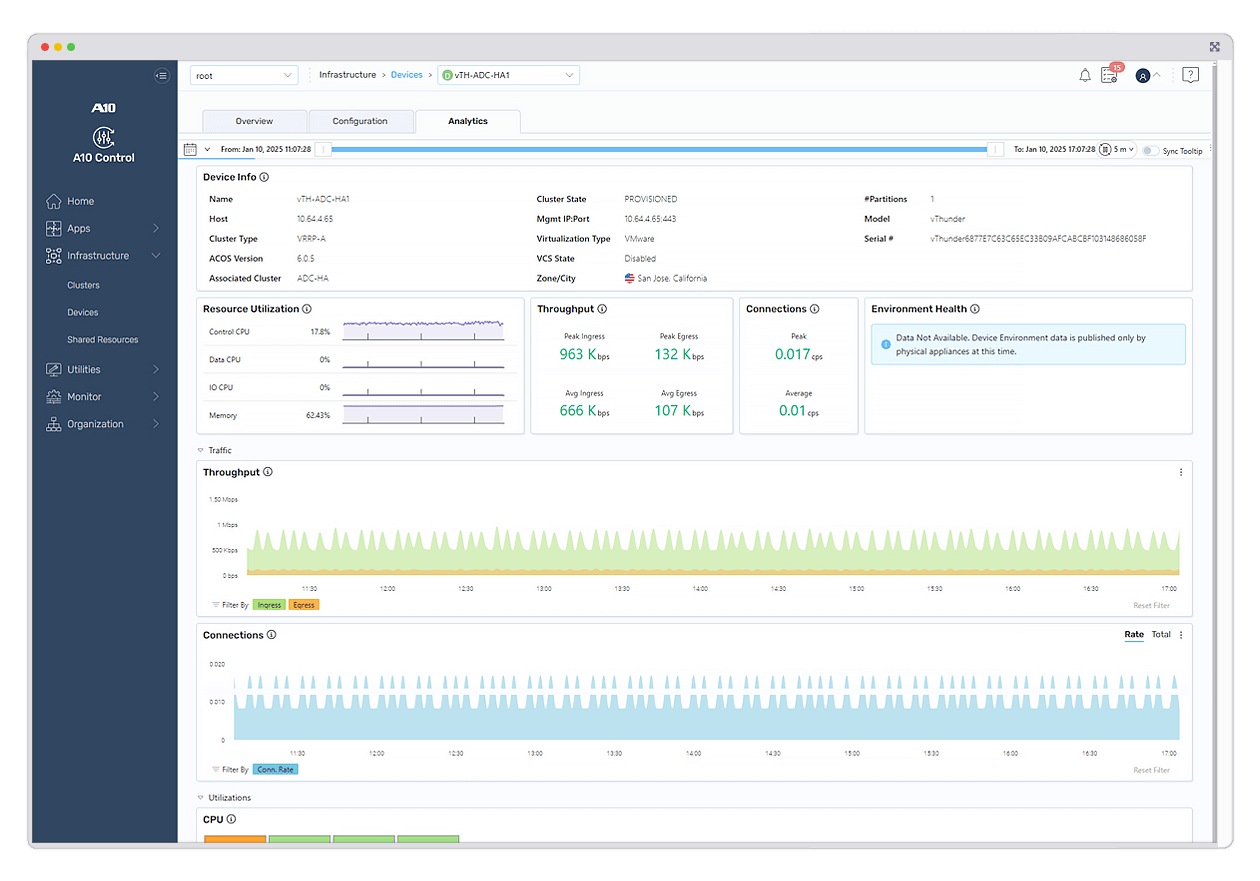
Thunder ADC integrates security functions such as SSL/TLS offload, single sign-on, DDoS protection, and a web application firewall, and connects to A10 Control for centralized management and per-application visibility. The platform also emphasizes automation, with full REST API coverage and integration into DevOps tools and Kubernetes environments.
Key features include:
- Advanced server load balancing: Provides full-proxy Layer 4–7 load balancing with agile traffic control, customizable service health checks, and aFleX scripting to manage how application traffic is distributed and kept available.
- Multi-cloud deployment and portability: Deploys in hardware, virtual, cloud, bare-metal, and container form factors, with FlexPool license portability that allows capacity to move across public, private, and hybrid cloud deployments.
- Performance acceleration: Improves transfer times with caching and TCP optimization and offloads cryptographic work through TLS/SSL offloading with support for modern ECC ciphers, helping preserve back-end server resources.
- Integrated web and DNS protection: Adds security functions including single sign-on, CAPTCHA, web and DNS firewalls, and DDoS protection to help secure services and meet compliance requirements.
- Multi-tenancy and access control: Supports strongly isolated or high-density multi-tenant deployments with role-based access control for customizable policies and appliance consolidation.
- Analytics and automation: Integrates with A10 Control for per-application visibility into user experience, traffic profiles, and health checks, and offers aXAPI REST programmability with full API coverage, global server load balancing, and integration with tools such as Terraform, Ansible, and Prometheus/Grafana.
Limitations (as reported by users on G2):
- WAF capabilities: Several users consider the WAF features insufficient and do not recommend the product where a WAF is the primary requirement.
- High-availability setup: One user reports that high-availability setup can be difficult to configure.
- CLI-dependent configuration: Reviewers note that some advanced settings can only be made from the command line.
- Pricing: Multiple users describe the product as expensive.
- Operational notes: Users mention that snapshot backups can interrupt service, and cite some complexity and concerns about vendor lock-in.
Source: A10 Networks
6. Progress Kemp LoadMaster

Best for: Organizations wanting full-featured load balancing at lower cost
Strengths: Broad L4/L7 features across virtual, hardware, and cloud
Things to consider: Interface feels dated and logging is fairly basic
Progress Kemp LoadMaster is a family of application delivery controllers and load balancers for cloud, Kubernetes, and on-premises environments, positioned around delivering an always-on application experience at an affordable price. It distributes traffic between application servers to support availability, scalability, and security, automatically detecting server outages and redirecting requests to healthy servers.
LoadMaster combines Layer 4 and Layer 7 load balancing and reverse proxy with SSL/TLS offload, global server load balancing, a built-in web application firewall, and authentication features. It is available as a virtual appliance, a hardware appliance, and a cloud deployment, with capacities ranging from 1 Gbps to uncapped. Kemp is part of the Progress portfolio and reports more than 100,000 deployments worldwide.
Key features include:
- Layer 4 and Layer 7 load balancing: Provides advanced Layer 4 and Layer 7 load balancing and reverse proxy with multiple session persistence options, application health checking, and the ability to deploy in high-availability pairs to maintain access during server failures.
- Built-in security: Includes a WAF covering the OWASP Top 10, pre-authentication (SAML, RADIUS, LDAP, Active Directory, Azure AD), single sign-on and multi-factor authentication, IP reputation with daily updates, and zero trust access control.
- Performance features: Supports SSL/TLS offload, content caching, compression, HTTP/2 to HTTP proxy, clustering, and direct server return, along with application templates for products such as Microsoft Exchange and ADFS to optimize delivery.
- Global server load balancing: Offers GSLB to direct traffic across sites, plus an IPv6/IPv4 bidirectional gateway and VLAN trunking and bonding, for distributing traffic across locations.
- Flexible deployment: Available as a Virtual LoadMaster (VMware, Hyper-V, Xen, KVM), a Hardware LoadMaster (1 Gbps to 90 Gbps), and a Cloud LoadMaster (AWS, Azure), with capacities from 1 Gbps to uncapped.
- Kubernetes and multi-cloud support: Provides a Kubernetes Ingress Controller and a single integrated platform intended to let DevOps, NetOps, and security teams manage delivery across hybrid and multi-cloud environments.
Limitations (as reported by users on G2):
- Dated interface: Reviewers describe the management GUI as dated and cluttered, and would like built-in guidance for more complex tasks.
- Learning curve and documentation: Some users note a learning curve and find parts of the documentation confusing.
- Basic logging and reporting: Users report that logs are simple and would like more detailed default reports and event information.
- Integration with other tools: One reviewer notes the product can operate in a silo and requires manual effort to keep it in sync with other platforms.
- Cost and occasional update bugs: Some users consider it expensive relative to what is provided and report occasional bugs introduced by updates.
まとめ
Application delivery solutions have become essential for modern IT infrastructure, providing the tools needed to maintain application performance, security, and availability across increasingly complex environments. As organizations adopt cloud-native, distributed, and API-driven architectures, these solutions enable scalable traffic management, enforce access policies, and optimize end-user experiences. By integrating performance acceleration, threat protection, and centralized control, application delivery platforms help enterprises meet demanding user expectations while maintaining resilience and control in hybrid and multicloud deployments.