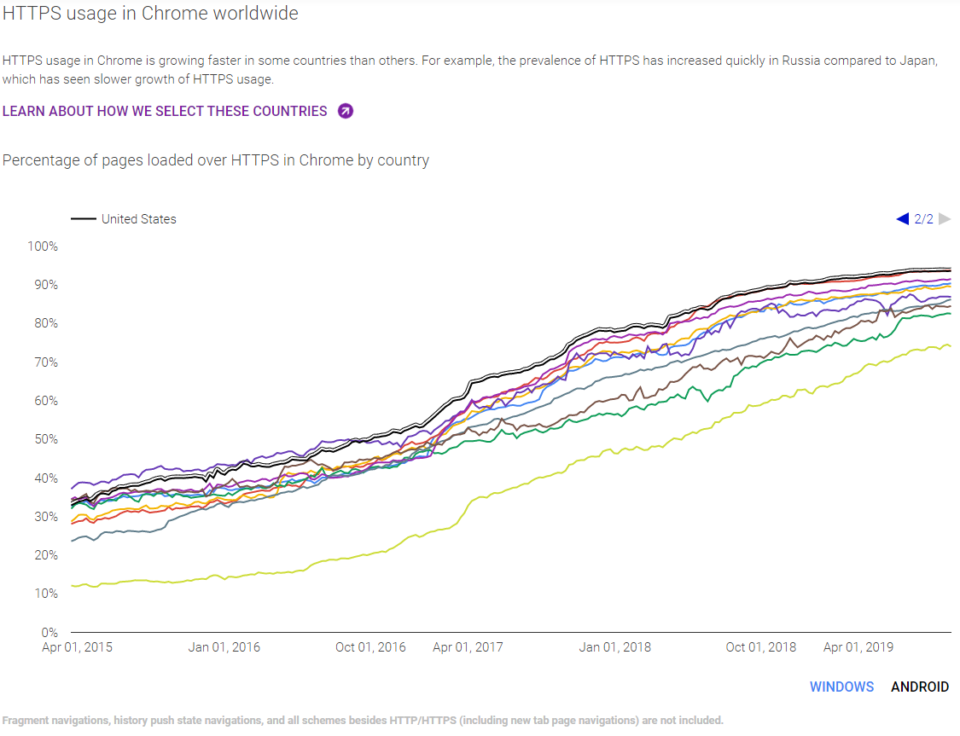
More than 70% of websites now use SSL encryption. The Google Transparency Report statistics below show a very rapid rise in adoptions of HTTPS for Chrome browser users worldwide.
Unfortunately, the security provided by SSL/TLS is also misused to attack applications by injecting malicious content and hide malware. SSL is also being used to facilitate data leakage from within an organization. HTTPS floods are now frequently used in many DDoS attack campaigns.
A Double Edged Sword
As more and more
applications and websites use end-to-end encryption and adopt HTTP/S and TLS
1.3, the ability to inspect traffic has become an important element of the
security posture. However, the encryption of traffic has made visibility
challenging.
Most DDoS mitigation services do not actually inspect SSL traffic, as doing so would require decrypting the traffic. Gaining visibility to SSL/TLS traffic also requires extensive server resources. Mitigating SSL attacks thus poses several challenges, including the burden of implementing encryption and decryption mechanisms at every point where traffic needs to be inspected.
[You may also like: High-Performance Visibility into SSL/TLS Traffic]
Encryption and decryption at many different points in the traffic data path not only adds latency to the traffic, but is also expensive and problematic to scale.
However, despite all the
challenges, SSL/TLS remain the standards for ensuring secure communications and
commerce on the web.
In order to detect any application security issues before your customers experience them, it is essential to have an end-to-end monitoring capability that provides actionable insights and alerts through visualization.
[You may also like: Detecting and Mitigating HTTPS Floods…Without Decryption Keys]
As application delivery controllers are deployed at the intersection of the network and applications, ADCs can act in conjunction with your edge protection solutions to detect and mitigate an encrypted security attack or prevent leakage of proprietary information.
まとめ
Even though you may be protected by the most advanced firewall technology, your existing security mechanisms may still fail to see into encrypted SSL/TLS traffic. You should deploy enterprise security solutions that enhances your existing security posture to gain visibility into the encrypted traffic and prevent encrypted attacks on your organization.

Read “Flexibility Is The Name of the Game” to learn more.
今すぐダウンロード