Summary: Application protection tools defend web apps and APIs from attacks, bots, and DDoS. Best overall: Radware for unified hybrid-cloud protection, Akamai for edge scale, Cequence for API security, and DataDome for bot defense.
What are Application Protection Tools?
Application protection tools are software solutions designed to defend applications against cyber threats, vulnerabilities, and malicious attacks. These tools operate at different layers of the application stack, providing defenses against a range of threats such as injection attacks, cross-site scripting, denial of service, and unauthorized access.
Their main objective is to protect critical business applications, APIs, and web workloads from exploitation, ensuring that sensitive data and operations remain secure and compliant. In addition to actively detecting and mitigating threats, these tools automate many of the tasks associated with security hardening, monitoring, and reporting.
Modern application protection solutions are integrated into the software development lifecycle, offering continuous security coverage from code development to production. This proactive approach allows organizations to respond to emerging threats faster and reduce the risk of data breaches, application downtime, and regulatory violations.
This is part of a series of articles about application security.
In this article:
Automated Vulnerability Detection
Automated vulnerability detection lets application protection tools scan code, dependencies, and deployed assets for known security risks without manual intervention. This process relies on up-to-date databases of common vulnerabilities and exposures (CVEs), pattern matching, and heuristic analysis to find flaws in real time. Developers and security teams receive alerts about misconfigurations, insecure coding practices, or outdated libraries, allowing rapid remediation before attackers can exploit weaknesses.
This continuous scanning can be integrated into CI/CD pipelines, supporting a "shift-left" security mindset. By catching vulnerabilities early in development and across the application's lifecycle, organizations reduce the risk of production issues, simplify patch management, and minimize the attack surface. Automated detection removes human error from the initial triaging of issues, simplifying security operations and enabling faster, consistent protection at scale.
Behavioral Analysis and Threat Blocking
Behavioral analysis in application protection focuses on monitoring how users and systems interact with applications to detect abnormal or suspicious activities. This capability often uses machine learning to build baselines of normal usage. If a user or process deviates from these baselines, such as unexpected API calls, excessive login attempts, or rapid data exfiltration, the tool flags the anomaly or actively blocks the threat.
Threat blocking mechanisms are usually tightly integrated with behavioral detection engines. When an attack pattern is recognized (for example, credential stuffing or automated scraping), the system can automatically apply security controls, such as blocking IP addresses, issuing CAPTCHAs, or enforcing rate limits.
Dependency Management and Compliance Reporting
Dependency management features in application protection tools automatically track open-source and third-party libraries used within the application stack. These tools continuously monitor for vulnerabilities disclosed in dependencies and assess the risk they pose to the application. If a library becomes a liability, the tool alerts developers and can even recommend secure alternatives or apply patches when feasible, simplifying the remediation process.
Compliance reporting capabilities are critical for organizations subject to regulations such as GDPR, HIPAA, or PCI DSS. Application protection tools automate the collection and presentation of evidence demonstrating adherence to relevant security standards. This includes audit trails of vulnerabilities, patch history, access logs, and incident response actions.
Binary Hardening (Obfuscation/Integrity Checks)
Binary hardening secures compiled application code from reverse engineering, tampering, and exploitation. Obfuscation techniques are applied to source or bytecode to make it difficult for attackers to understand or manipulate application logic. This includes renaming variables, encrypting code sections, or using anti-debugging routines. Even if attackers gain access to binaries, the risk of unauthorized modification or intellectual property theft is greatly reduced.
Integrity checks ensure that code and data resources have not been altered by unauthorized actors. Application protection tools embed runtime checksums, digital signatures, or hash verifications that trigger alerts or halt execution when tampering is detected. These combined hardening strategies are particularly valuable for mobile apps, client-side scripts, and distributed systems where code is exposed to broader attack surfaces.
WAF Virtual Patching
Virtual patching allows organizations to quickly address critical vulnerabilities at the network or application perimeter, often via a web application firewall (WAF), before an official software patch becomes available. This is done by creating custom WAF rules or signatures that block exploit attempts targeting the disclosed vulnerability, buying valuable time for development teams to implement and test a permanent fix.
This approach is crucial when facing zero-day exploits or vulnerabilities in legacy or third-party software where patching may be delayed. Virtual patching does not modify the underlying application but provides immediate mitigation within minutes or hours of a threat's disclosure. This capability reduces risk exposure during the patch window.
The table below summarizes the key differences between the application protection tools covered in this article. We explore each solution in more detail in the sections that follow.
| Category |
ソリューション |
Best For |
Key Strengths |
Things to Consider |
| Comprehensive WAAP Platforms |
Radware Cloud Application Protection Service |
Unified web app and API protection across hybrid and multi-cloud |
Integrated WAF, bot, API, DDoS, and client-side modules |
Several advanced capabilities are delivered as separate modules |
| Comprehensive WAAP Platforms |
Akamai App & API Protector |
Edge-delivered protection for web apps and APIs at scale |
WAF, Layer 7 DDoS, API discovery, and bot controls in one solution |
Configuration changes can take time to deploy across the network |
| Comprehensive WAAP Platforms |
Gcore WAAP |
Edge-delivered WAAP for apps and APIs that need low latency |
Combines WAF, bot management, DDoS, and API security at the edge |
Newer WAAP offering with a limited public review base |
| Comprehensive WAAP Platforms |
F5 Distributed Cloud WAF |
Consistent WAF policy across clouds, on-premises, and edge |
Signature and behavioral detection with AI-powered risk scoring |
Configuration depth carries a steep learning curve |
| API Security & Bot Management |
Cequence |
API discovery, posture management, testing, and protection |
Inside-out and outside-in discovery with native bot mitigation |
Initial policy setup is complex and dashboards can lag under load |
| API Security & Bot Management |
Salt Security |
API discovery, posture management, and behavioral threat detection |
Agentless discovery and behavioral analysis across the API estate |
Reporting is limited and some features are still maturing |
| API Security & Bot Management |
DataDome |
Real-time bot, AI agent, and online fraud protection |
Edge detection in milliseconds with a low false-positive rate |
Cost scales with traffic and tuning can require effort |
How we selected these tools: We shortlisted application protection tools based on their ability to defend web applications and APIs against OWASP risks, automated bots, application-layer DDoS, and API abuse across cloud, hybrid, and on-premises environments.
1. Radware Cloud Application Protection Service

Best for: Unified web app and API protection across hybrid and multi-cloud.
Strengths: Integrated WAF, bot, API, DDoS, and client-side modules.
Things to consider: Several advanced capabilities are delivered as separate modules.
Radware Cloud Application Protection Service is a cloud-delivered platform that secures web applications, APIs, and infrastructure through a set of integrated protection modules. The modules share attack data and coordinate responses, and Radware applies AI-driven analysis across them to connect signals from different engines. The service covers OWASP risk categories for web application security, API security, client-side security, automated threats, and LLM security. It runs across on-premises, Kubernetes, hybrid, and public cloud environments, applying the same protection regardless of where applications are hosted. It is available as a managed service backed by a 24x7 Emergency Response Team.
Key features include:
- Web application firewall: The Cloud WAF learns the behavioral patterns of application traffic and refines security policies over time. It uses an automated positive security model to reduce exposure to zero-day attacks and covers known OWASP web application vectors. Policies update automatically using behavioral algorithms to limit false positives.
- API protection: Discovers APIs automatically and builds tailored security policies through continuous AI-driven mapping of API traffic. It analyzes business logic to identify and stop API-specific attacks in real time. It addresses the OWASP API security risk categories.
- Bot management: Distinguishes between human traffic, good bots, and bad bots across websites, mobile apps, and APIs. It filters automated activity to mitigate bot attacks. It also detects large-scale distributed account takeover attempts using behavioral analysis.
- Application-layer DDoS protection: Detects and mitigates HTTP and HTTPS-based DDoS attacks using behavioral-based algorithms. It is built to handle high-volume Web DDoS attacks. Detection and mitigation are automated to shorten response time.
- Client-side protection: Monitors third-party services in the application supply chain to protect end-user data during interactions. It addresses supply-chain attacks embedded in the application. It works alongside the other protection modules.
- LLM Firewall: Provides real-time protection at the prompt level for generative AI use. It stops threats before they reach the LLM model. It enforces company policies for compliant output.
Limitations (as reported by users on G2):
- Reporting customization: Some users note that reporting and dashboards are template-based and would benefit from more flexible, higher-level executive views.
- Initial configuration effort: Setting up policies and tuning the service to an environment can take time and benefits from experienced staff.
- Modular packaging: Certain advanced capabilities are delivered as separate modules, which some users would prefer to see bundled.
2. Akamai App & API Protector

Best for: Edge-delivered protection for web apps and APIs at scale.
Strengths: WAF, Layer 7 DDoS, API discovery, and bot controls in one solution.
Things to consider: Configuration changes can take time to deploy across the network.
Akamai App & API Protector is a security solution that protects websites, applications, and APIs from a single platform delivered at the Akamai edge. It combines a web application firewall, Layer 7 DDoS defense, API discovery, bot management, and sensitive data protection. Its Adaptive Security Engine learns attack patterns from traffic across Akamai's network and adjusts protections in response. Every request is inspected in real time to defend against web application and API attacks, DDoS, and malicious bots. The Hybrid version extends WAF protections beyond the edge to on-premises, hybrid cloud, and multi-CDN environments.
Key features include:
- Adaptive Security Engine: Learns attack patterns and updates defenses automatically, including for zero-day vulnerabilities and new CVEs. It pushes the latest application and API protections without manual rule writing. It draws on threat intelligence from across Akamai's network.
- Behavioral DDoS Engine: Detects and mitigates large-scale Layer 7 DDoS attacks based on traffic patterns. It provides automated defense against volumetric attacks. It operates at the edge to block attacks before they reach the origin.
- API discovery and protection: Identifies known and unknown APIs and monitors them for risk. It applies WAF protections and sensitive data controls to API traffic. Discovery data is presented for review and policy creation.
- Bot management: Includes controls to identify and manage automated traffic. It distinguishes legitimate automation from malicious bots. It is part of the single all-in-one solution alongside WAF and DDoS controls.
- DevOps integration: Supports deployment through a GUI, the Akamai CLI, a Terraform provider, and public APIs. It can operate within a CI/CD pipeline. It includes a public Postman collection for automation.
- Malware protection: Scans files at the edge to prevent attackers from reaching the origin. AI-powered dashboards surface anomalies. They also recommend remediation actions.
Limitations (as reported by users on PeerSpot):
- Configuration deployment time: Pushing a configuration change across the network and retracting it can each take around twenty minutes, slowing iteration.
- Pricing: Reviewers describe the solution as expensive relative to some alternatives.
- Documentation and support gaps: Some find the knowledge base incomplete on details such as rule precedence, and support response times can be slow.
- Console and reporting visibility: Custom rules and analytics visibility in the console are seen as areas for improvement, and the interface can feel complex.
- Bot management tuning: Bot management can require significant manual fine-tuning and hands-on setup.
3. Gcore WAAP

Best for: Edge-delivered WAAP for apps and APIs that need low latency.
Strengths: Combines WAF, bot management, DDoS, and API security at the edge.
Things to consider: Newer WAAP offering with a limited public review base.
Gcore WAAP is a web application and API protection platform that secures websites, applications, and APIs against threats including zero-day vulnerabilities, bots, and DDoS attacks. It combines a web application firewall, bot management, DDoS protection, and API security in one service delivered at the edge. Traffic is routed through Gcore's edge network for continuous monitoring, using anomaly detection, behavioral analysis, and machine learning to identify threats. Malicious requests are blocked at the edge, with rate limiting, input validation, and authentication applied before traffic reaches the application. The platform includes auto-learning and self-tuning along with manual rule controls.
Key features include:
- Web application firewall: Defends against OWASP Top 10 risks and other web application threats. It operates as a reverse proxy layer in front of applications. Rules can be auto-tuned or set manually.
- Bot management: Identifies and filters automated traffic across web and API endpoints. It mitigates bots as part of the multi-layered protection. It works alongside the WAF and DDoS modules.
- DDoS protection: Provides protection against volumetric and application-layer DDoS attacks. Mitigation happens at the edge to maintain availability. It is included within the single WAAP service.
- API security: Protects API traffic against misuse, abuse, and data exposure. It applies protection without changes that impact application performance. It covers API-specific threats alongside web application risks.
- AI-driven threat detection: Uses machine learning to detect evolving threats and supports customizable security policies. A three-stage detect, mitigate, and adapt process runs at the edge. Security processing is distributed across Gcore's global points of presence.
- Compliance support: Supports GDPR, ISO 27001, and PCI DSS requirements. It addresses data residency needs. It helps meet data sovereignty requirements.
Limitations (based on publicly available sources):
- Cost: Available analysis and the limited published feedback cite cost as a concern.
- Limited pricing transparency: Only the entry tier is published publicly, with higher tiers requiring sales engagement.
- Product maturity: The WAAP offering is newer than longer-established competitors, with a smaller ecosystem of integrations and community resources.
- Limited public validation: There is a very small base of public peer reviews available for evaluation.
4. F5 Distributed Cloud WAF

Best for: Consistent WAF policy across clouds, on-premises, and edge.
Strengths: Signature and behavioral detection with AI-powered risk scoring.
Things to consider: Configuration depth carries a steep learning curve.
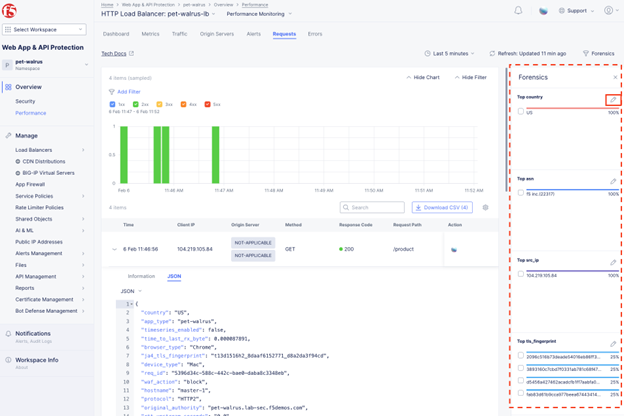
F5 Distributed Cloud WAF is a SaaS-delivered web application firewall that secures applications across public clouds, on-premises data centers, and edge locations under consistent policy. It acts as an intermediate proxy that inspects application requests and responses to block risks including OWASP Top 10 attacks, threat campaigns, malicious users, Layer 7 DDoS, and bots. It combines a signature engine with a behavioral engine that scores client interactions to identify the highest-priority threats. AI-powered risk scoring is layered on top to improve detection with less manual tuning. It can be self-managed or run as a managed service supported by F5's SOC.
Key features include:
- Attack signature engine: Captures CVEs and known vulnerabilities and techniques identified by F5 Labs, including Layer 7 DDoS, threat campaigns, bots, and automated threats. It provides signature-based blocking of known attacks. Signatures are maintained by F5.
- Behavioral analysis engine: Monitors and scores client interactions based on factors such as WAF rules triggered, forbidden access attempts, login failures, and error rates. It deciphers intent to prioritize threats. It can act on suspicious clients that do not trigger known signatures.
- Service policy engine: Enables micro-segmentation and application-layer controls. It uses IP reputation and allow and deny lists. It can block clients by TLS fingerprint or by ASN associated with suspicious regions.
- Automatic signature tuning: Evaluates whether a signature-identified attack is a real threat to reduce false positives. This lowers manual tuning effort. It works alongside AI-powered risk scoring.
- Deployment and management: Deploys through a UI or via APIs, with default protections and custom rule options. It protects workloads across AWS, Azure, GCP, on-premises, and F5 global points of presence. It supports Terraform, a CLI, and integrations with SIEM and alerting tools.
- AI assistant: Provides a natural language interface with insights and recommendations. It returns real-time information on distributed apps and APIs. It summarizes data reports.
Limitations (as reported by users on G2):
- Configuration complexity: Reviewers describe complex configuration and a steep learning curve that assumes familiarity with many platform settings.
- Default false positives: Default configurations can generate false positives that affect end users until they are tuned.
- Availability incidents: Some users have reported extended platform outages.
- Interface and logging: The GUI and log dashboard are cited as areas needing improvement, and log searches can become complex.
- Coverage scope: The focus is on Layer 7, with limited help for Layer 3 and 4 attacks.
Source: F5
API Security & Bot Management
5. Cequence

Best for: API discovery, posture management, testing, and protection.
Strengths: Inside-out and outside-in discovery with native bot mitigation.
Things to consider: Initial policy setup is complex and dashboards can lag under load.
Cequence API Security discovers, monitors, and tests APIs while assessing risks that can lead to compliance issues, data loss, and business disruption. It is part of the Cequence platform, which protects web, mobile, API, and AI channels against attacks, business logic abuse, and fraud. It combines inside-out and outside-in discovery to map an organization's API attack surface and build a runtime inventory. It assesses APIs for access control issues, sensitive data exposure, and compliance with published specifications. It integrates with existing infrastructure such as API gateways or can be deployed inline.
Key features include:
- API discovery and inventory: Discovers internal, external, and third-party APIs along with edge, infrastructure, gateway, and hosting providers. It combines inside-out and outside-in discovery for attack surface and internal visibility. It integrates with API gateways or deploys inline.
- Continuous risk visibility: Identifies documented, undocumented, third-party, and shadow APIs to build a runtime catalog. It assesses APIs for access control, sensitive data leakage, and specification compliance, generating specifications when not available. Rules and prioritization are user-configurable without coding.
- Sensitive data protection: Identifies and masks sensitive data using machine-learning rules with predefined and custom patterns. It supports data patterns worldwide and differentiates between regional identifiers. It locates sensitive data without requiring explicit definition of which APIs handle it.
- API security testing: Tests APIs in pre-production and at runtime to identify vulnerabilities and coding errors. Test plans can be generated automatically from Postman collections or API specifications. It supports CI/CD pipelines, IDEs, and standalone testing.
- Traffic flow visualization: The Flow Graph maps API interactions, dependencies, and how information moves through the API infrastructure. It validates expected paths and detects anomalies. It surfaces shadow and rogue APIs.
- Attack protection: Protects web, mobile, and API applications using machine-learning threat detection and analytics, and integrates with WAFs and API gateways. Native bot management provides blocking, logging, rate limiting, header injection, and deception.
Limitations (as reported by users on G2):
- Setup complexity: Initial setup and policy configuration are described as complex and time-consuming to get right.
- Dashboard performance: Large data queries can cause the dashboard to lag, with slower response under heavy load.
- Learning curve and drill-down: The interface takes time to learn, and users want better drill-down from summary views into related events.
- Detection learning delay: Rules need time to learn before they block or mitigate traffic, which can delay response.
- Documentation: Reviewers note gaps in onboarding materials such as in-portal video training.
6. Salt Security
Best for: API discovery, posture management, and behavioral threat detection.
Strengths: Agentless discovery and behavioral analysis across the API estate.
Things to consider: Reporting is limited and some features are still maturing.
Salt Security provides an API security platform that gives visibility into an organization's APIs and detects API attacks. It discovers APIs running in production across environments, including shadow APIs, third-party connections, and deprecated endpoints, without manual tagging or agents. It continuously analyzes API posture and maps it to frameworks such as PCI DSS, GDPR, NIST, and SOC 2, showing where controls are missing or misaligned. Its behavioral analysis detects API-specific threats, fraud patterns, and low-and-slow attacks over time. The platform connects discovery, posture, and threat detection, and integrates with existing tools such as SIEMs, ticketing systems, and firewalls.
Key features include:
- API discovery and visibility: Provides real-time visibility into every API running in production across environments. It identifies shadow APIs, third-party connections, and deprecated endpoints. It operates without manual tagging or agents.
- Posture and compliance management: Continuously analyzes API posture and maps it to frameworks including PCI DSS, GDPR, NIST, and SOC 2. It shows where controls are missing, misaligned, or out of date. Governance can be enforced at scale through a policy hub.
- Behavioral threat detection: Uses behavioral analysis to detect API-specific threats, fraud patterns, and low-and-slow attacks. It correlates activity over time to identify attacker intent earlier than point-in-time tools. It connects detection to posture and discovery.
- Data and exposure mapping: Maps the interconnected set of APIs that power applications and services. It tracks sensitive data moving through APIs. It surfaces exposed endpoints to reduce attack surface.
- Stack integrations: Integrates with tools teams already use, including SIEMs, Jira, and firewalls. Alerts can be enriched in a SIEM and gaps closed through tickets. It can support blocking at a firewall.
- Modular capabilities: Offers components for external exposure mapping, cloud API visibility, live traffic analysis, and policy enforcement. These cover different stages of the API lifecycle. They operate within the single platform.
Limitations (as reported by users on G2):
- Maturing feature set: Reviewers describe the product as relatively new, with some capabilities still being built out.
- Reporting and analytics: Several note the absence of a dedicated reporting module and want more detailed data extraction.
- Logging integrations: SIEM logging integrations are reported to lack native action logging.
- API gateway handling: Some users had difficulty getting APIs routed through a gateway to report correctly.
- Interface consistency: Tagging can be inconsistent across dashboards, and users want clearer visualization of API call chains.
7. DataDome

Best for: Real-time bot, AI agent, and online fraud protection.
Strengths: Edge detection in milliseconds with a low false-positive rate.
Things to consider: Cost scales with traffic and tuning can require effort.
DataDome is a bot protection solution that secures websites, mobile apps, APIs, and MCP servers against automated threats in real time. It analyzes every request, evaluating hundreds of client-side and server-side signals to assess risk throughout the user journey. Its AI detection engine processes large volumes of signals daily using many models plus collective threat intelligence to distinguish human users, legitimate AI agents, and malicious bots. It operates at the edge across a global network of points of presence, mitigating attacks in milliseconds. It addresses use cases including scraping, account takeover, scalping, payment fraud, and Layer 7 DDoS.
Key features include:
- Real-time bot detection: Analyzes every request rather than sampled traffic, evaluating hundreds of signals continuously. It uses AI models and collective threat intelligence to classify traffic. It distinguishes humans, trusted AI agents, and malicious bots.
- Edge mitigation: Operates at the edge across global points of presence, responding in under a few milliseconds. It mitigates threats without adding noticeable latency. It maintains a low false-positive rate to limit friction for real users.
- Automated response: Triggers automated mitigation aligned with business logic when high-risk traffic is detected. It acts without manual intervention. Responses are designed to fit the application flow.
- Agent trust management: Identifies, classifies, scores, and governs agentic AI traffic. It validates the identity and intent of AI agents in real time. It allows verified agents while blocking malicious automation.
- Threat dashboard: Provides visibility into threats by type over time with drill-down into specific attacks. It supports endpoint discovery, custom dashboards, saved views, and reports. It surfaces AI-generated summaries by persona.
- Coverage and privacy: Addresses use cases including content and LLM scraping, account takeover, scalping, carding, and Layer 7 DDoS. It uses two-layer PII encryption to support GDPR and CCPA requirements. A 24x7 SOC team monitors traffic and model performance.
Limitations (as reported by users on G2):
- Cost: Pricing is described as premium and scales with traffic volume, which can be a barrier for smaller organizations.
- False positives: Strict detection can occasionally block legitimate users or add challenges during traffic spikes, requiring tuning.
- Integration effort: Initial setup and fine-tuning take effort in complex environments, and mobile SDK implementation can be involved.
- Support tiering: Priority technical support is tied to higher-cost plans, and some users report slower response times.
- Customization limits: Rate-limiting, rule management, and dashboard customization options are seen as limited, and some changes require DataDome involvement.
まとめ
Effective application protection requires layered defenses that address vulnerabilities in code, dependencies, runtime behavior, and exposed interfaces. The most capable solutions combine automated detection, behavioral analytics, binary hardening, and rapid patching mechanisms to close gaps before attackers can exploit them. By embedding these protections into development and deployment workflows, organizations can maintain security resilience against both known and emerging threats while minimizing operational disruption.