What are Cybersecurity Solutions?
Summary: Cybersecurity solutions for application protection secure apps and APIs from code to runtime. Best overall: Radware for unified cloud app and API protection; Imperva and F5 for WAFs; Checkmarx for AppSec testing.
Cybersecurity solutions for application protection include a variety of tools and strategies focused on securing applications from threats throughout their lifecycle. These solutions range from penetration testing and static code analysis early in development to runtime application protection like WAFs and RASPs during operation. Key areas include API security, bot management, and web application security.
The table below summarizes the key differences between the solutions covered in this article. We explore each one in more detail in the sections that follow.
| Category |
ソリューション |
Best For |
Key Strengths |
Things to Consider |
| Web App & API Protection |
ラドウェア |
Unified cloud protection for web apps and APIs |
WAF, API, bot, client-side and L7 DDoS in one managed service |
Pricing can be high; partner-routed support can add delay |
| Web App & API Protection |
Imperva |
Blocking web and API attacks with low false positives |
Managed rules, ML analytics, flexible deployment |
Reporting is limited; pricing can be costly |
| Web App & API Protection |
F5 BIG-IP Advanced WAF |
Apps and APIs with deep, customizable policies |
Behavioral L7 DoS defense, API protocol security, security-as-code |
Complex configuration; higher cost than cloud WAFs |
| Application Security Testing |
Checkmarx |
Securing code across the SDLC, IDE to runtime |
Hybrid scanning, ASPM risk correlation, in-IDE remediation |
False positives; slower scans on large codebases |
| Application Security Testing |
Snyk |
Developer-first security for code, deps, containers, IaC |
In-IDE and pull-request fixes with CI/CD integration |
False positives and cost can grow at scale |
| Application Security Testing |
Veracode |
Enterprise application security testing across the SDLC |
SAST, DAST, SCA, ASPM and AI remediation in one platform |
Slower scans; interface some users find dated |
Key cybersecurity solutions for application protection include:
- Web application firewalls (WAFs): Protect web applications by filtering malicious traffic and blocking attacks.
- Bot management: Identifies and mitigates malicious bot traffic targeting applications.
- API security: Secures APIs by discovering, monitoring, and auditing API activity.
- Web DDoS protection: Defends against application-layer denial-of-service attacks by filtering malicious HTTP requests.
- Client-side protection: Secures browser environments from malicious scripts, supply chain attacks, and unauthorized data exfiltration.
- Kubernetes-native web application and API protection (WAAP): Extends traditional WAF and API security to containerized and microservices environments.
- Penetration testing: Simulates cyberattacks to identify vulnerabilities in applications before they are deployed.
- Static code analysis: Analyzes application source code to detect security flaws and vulnerabilities.
- Cloud-native application protection platforms (CNAPP): Provide security for cloud-native applications, encompassing various security aspects from code to cloud.
- Endpoint detection and response (EDR): Monitors devices and applications for suspicious activity and provides real-time threat detection and response.
- Data encryption: Protects sensitive data at rest and in transit.
- Identity and access management: Ensures that only authorized users can access applications and data.
- Account Takeover (ATO) protection: Detects and prevents unauthorized logins through behavioral analysis, device fingerprinting, and anomaly detection.
- LLM protection: Protects large language models from prompt injection, data leakage, and adversarial manipulation.
- Agentic AI management: Controls and monitors autonomous AI agents through governance, sandboxing, and behavior auditing.
Editor's note: Added recent data about the application protection market and updated information for security solutions to reflect features and capabilities in 2026.
In this article:
Market Size and Growth Forecast
According to recent market research, the global application security market is expanding rapidly as organizations increase investments in protecting web and mobile applications. The market was valued at USD 10.65 billion in 2025 and is projected to reach USD 42.09 billion by 2033, growing at a compound annual growth rate (CAGR) of 18.8%.
This growth is largely driven by the rise in cyberattacks targeting applications. As businesses digitize operations and rely more heavily on web and mobile platforms, attackers increasingly exploit vulnerabilities to gain unauthorized access or steal sensitive data. As a result, organizations are investing in solutions such as web application firewalls (WAFs), runtime application self-protection (RASP), and application security testing tools.
Increasing Threats to Web and Mobile Applications
The surge in sophisticated attacks against web and mobile applications is a primary driver of market growth. Vulnerabilities such as SQL injection, cross-site scripting (XSS), and session hijacking are frequently exploited to compromise applications.
To address these risks, enterprises are deploying security tools that can detect and mitigate vulnerabilities during both development and runtime. Technologies such as SAST, DAST, bot management systems, and runtime protection solutions are becoming standard components of modern application security strategies.
Cloud Adoption and Expanding Attack Surfaces
The shift toward cloud computing, SaaS platforms, and microservices architectures has significantly expanded the attack surface for organizations. Applications are now deployed across hybrid and multi-cloud environments, making consistent security enforcement more complex.
Many organizations are adopting cloud-native application protection platforms (CNAPPs) and integrating security into DevSecOps pipelines to address these challenges. According to the 2025 State of Cloud Security Report by Orca Security, 55% of organizations now use two or more cloud providers, increasing the need for centralized security visibility, policy enforcement, and vulnerability monitoring.
Growing Demand for Integrated Security in DevOps
Another major trend is the integration of security tools directly into CI/CD pipelines. Organizations increasingly embed security testing into development workflows to identify vulnerabilities earlier in the software lifecycle.
Automated tools enable continuous scanning, real-time vulnerability detection, and faster remediation, reducing the risk of deploying insecure applications. This shift toward developer-friendly, automated security solutions is contributing significantly to market growth.
Web Application Firewalls (WAFs)
Web Application Firewalls (WAFs) are security appliances or cloud-based services that filter and monitor HTTP traffic between users and web applications. WAFs are specifically designed to block attacks that target web application vulnerabilities, such as SQL injection, cross-site scripting (XSS), and other OWASP Top 10 threats.
WAFs operate at the network edge or within the application stack, providing flexible deployment options for on-premises, hybrid, or cloud environments. Advanced WAFs utilize machine learning to adapt to new attack patterns, reduce false positives, and automatically update protection policies.
APIセキュリティ
API security addresses the unique risks associated with application programming interfaces, which enable data exchange and functionality integration between applications or services. Poorly secured APIs can expose sensitive data, introduce vulnerabilities, or allow unauthorized transactions. Robust API security involves authentication, authorization, input validation, rate limiting, and monitoring for abuse and misuse.
As microservices and serverless architectures expand, APIs have become a primary target for attackers. Dedicated API security solutions detect and block malicious requests, prevent data leaks, and provide visibility into API traffic. Effective API security strategies also include regular testing, documentation, and adherence to industry standards such as OAuth and OpenAPI.
ボット管理
Bot management focuses on detecting, categorizing, and controlling automated traffic to web applications. While some bots serve legitimate purposes, such as search engine indexing, malicious bots can engage in credential stuffing, data scraping, account takeover, and denial-of-service attacks.
Bot management solutions use behavioral analysis, intent detection, device fingerprinting, and machine learning to differentiate good bots, bad bots, and human users. These systems integrate with WAFs and other security layers to block harmful automated activities without disrupting legitimate site usage or customer experience.
Web DDoS Protection (HTTP/L7/application layer DDoS Protection)
Application-layer DDoS attacks overwhelm web servers and APIs by flooding them with seemingly legitimate HTTP requests. Unlike volumetric attacks at the network layer, L7 DDoS attacks are harder to detect because they mimic normal user traffic. Web DDoS protection solutions focus on analyzing request patterns, identifying anomalies, and applying rate-limiting or challenge-response mechanisms to filter malicious traffic.
Modern Web DDoS defenses use machine learning to distinguish real user activity from automated attack traffic. They also integrate with CDNs and cloud scrubbing services for scalable mitigation during high-intensity events.
クライアントサイド防御
Client-side protection addresses risks that occur in the user's browser, particularly from malicious scripts and supply chain attacks such as Magecart. Attackers often inject code into third-party JavaScript libraries or payment forms to capture sensitive data like credit card numbers and personal details. These attacks bypass server-side defenses since the compromise happens in the browser.
Solutions provide real-time script monitoring, integrity validation, and runtime policy enforcement. They track changes in third-party scripts, block unauthorized data exfiltration, and alert teams to suspicious behaviors. As modern applications increasingly rely on third-party integrations, client-side protection is critical to ensuring end-to-end application security.
Kubernetes WAAP/WAF
Kubernetes-native web application and API protection (WAAP) extends the capabilities of traditional WAFs to containerized and microservices-based environments. Unlike monolithic applications, Kubernetes workloads are highly dynamic, with frequent scaling, service discovery, and ephemeral instances.
Key features include API discovery, schema validation, and protection against injection, credential stuffing, and bot-driven attacks. Kubernetes WAAP solutions integrate at the ingress controller or service mesh layer, ensuring consistent security enforcement across services. Many also support policy automation through Kubernetes-native configurations (e.g., CRDs), enabling security teams to apply protection directly within DevOps workflows.
Penetration Testing
Penetration testing, or ethical hacking, is a proactive security practice where authorized experts simulate real-world cyberattacks to identify vulnerabilities in applications before malicious actors can exploit them. This process involves systematic scanning, exploitation, and analysis of potential entry points in code, configurations, and deployed environments.
Penetration testing uncovers flaws such as injection vulnerabilities, misconfigurations, and logic errors that automated security tools might miss. Routine penetration testing is crucial for maintaining a strong security posture, especially when applications are updated or deployed in new environments. Regulatory frameworks like PCI DSS and ISO 27001 often require regular penetration testing.
Static Code Analysis
Static code analysis inspects application source code or binaries for security weaknesses without executing the program. Automated tools scan codebases for known vulnerabilities, insecure coding practices, and policy violations, providing developers with actionable insights early in the software development lifecycle.
By identifying issues such as hardcoded credentials, buffer overflows, and unvalidated input, static analysis improves code quality and reduces the risk of introducing exploitable weaknesses into production. Adopting static code analysis as part of continuous integration/continuous deployment (CI/CD) pipelines enables organizations to catch security flaws before they progress further in the build process.
Endpoint Detection and Response (EDR)
Endpoint Detection and Response (EDR) is an advanced security solution that monitors endpoints, such as servers, desktops, and mobile devices, for suspicious activities and potential threats. EDR tools collect, analyze, and correlate large volumes of telemetry data in real time to detect malware, ransomware, and zero-day attacks targeting endpoints.
When anomalies are identified, EDR can automatically trigger containment and mitigation actions to stop the spread of threats. EDR systems complement other application protection measures by addressing the risk of lateral movement and remote exploitation through compromised endpoints.
Cloud-Native Application Protection Platforms (CNAPP)
Cloud-Native Application Protection Platforms (CNAPP) provide end-to-end security for applications built and deployed using cloud-native technologies such as containers, Kubernetes, and serverless functions. CNAPP solutions combine capabilities like vulnerability scanning, configuration management, runtime protection, and compliance monitoring into a unified platform tailored for dynamic cloud environments.
CNAPP platforms integrate closely with DevOps pipelines, offering remediation guidance and automated policy enforcement throughout the application lifecycle. Support for multi-cloud and hybrid deployments ensures consistent protection as applications move across infrastructure boundaries.
Data Encryption
Data encryption transforms information into unreadable code to prevent unauthorized access during storage (data at rest) and transmission (data in motion). By applying strong encryption algorithms, organizations can ensure that sensitive data such as financial records, personal information, or intellectual property remain secure even if intercepted or stolen.
Effective application protection requires encryption to be integrated at multiple levels, including databases, files, APIs, and communications. Key management practices, such as secure key storage and rotation, are vital to maintaining the reliability of encryption.
Identity and Access Management
Identity and Access Management (IAM) serves as the foundation for application security by controlling who can access resources and what actions they are authorized to perform. IAM solutions employ techniques like single sign-on (SSO), multi-factor authentication (MFA), and role-based access control (RBAC) to ensure only verified users gain entry to systems or data.
Properly implemented IAM minimizes the risk of unauthorized access, data breaches, and insider threats, which are among the leading causes of application-related security incidents. Beyond basic authentication, IAM also incorporates policy enforcement, user provisioning, and ongoing monitoring to detect suspicious activity. Integrating IAM with user behavior analytics can uncover compromised accounts or privilege misuse.
ATO防御
Account takeover (ATO) protection focuses on detecting and preventing unauthorized access to user accounts. Attackers often exploit weak credentials, credential stuffing, and phishing to hijack legitimate accounts and bypass traditional perimeter defenses. ATO protection uses techniques such as device fingerprinting, behavioral biometrics, and anomaly detection to identify suspicious login attempts and block them before compromise occurs.
Effective ATO solutions analyze login velocity, unusual geolocation access, and deviations in user behavior. When integrated with IAM and MFA, they provide adaptive authentication challenges, balancing user experience with security. Preventing ATO is critical for protecting customer trust, protecting sensitive data, and reducing fraud across applications.
LLM Protection
LLM protection solutions secure large language models (LLMs) and generative AI applications against prompt injection, data leakage, and model manipulation. Since LLMs can interact with sensitive business systems and data, they introduce new attack vectors, including adversarial prompts, training data poisoning, and output manipulation.
LLM firewalls and gateways provide guardrails by filtering user inputs, monitoring model responses, and enforcing security policies. They integrate with existing API gateways to prevent exfiltration of sensitive data and restrict risky behaviors. For organizations deploying GenAI-driven applications, these protections ensure compliance, reduce misuse, and maintain reliability in production environments.
Agentic AI Management and Security
Agentic AI systems, which use autonomous agents to make decisions and execute tasks, require specialized security controls. Unlike traditional applications, agentic AI can perform actions across multiple environments, making them susceptible to manipulation, privilege escalation, and unintended behaviors.
Security solutions for agentic AI focus on action governance, sandboxing, and continuous monitoring of agent behavior. They enforce boundaries on what agents can access, apply audit trails for decisions, and use anomaly detection to flag unexpected activity. As organizations adopt autonomous AI for operations, customer support, and DevOps automation, strong management and security controls are necessary to maintain trust, compliance, and resilience.
How we selected these tools: We shortlisted cybersecurity solutions for application protection based on their coverage of web application and API security, runtime and DDoS protection, and application security testing across the development lifecycle.
Web Application and API Protection
1. Radware Cloud Application Protection Service

Best for: Unified cloud protection for web apps and APIs across hybrid setups.
Strengths: WAF, API, bot, client-side and L7 DDoS in one managed service.
Things to consider: Pricing can be high; partner-routed support can add delay.
Radware Cloud Application Protection Service, delivered as Radware Cloud WAF, is a fully managed service that combines web application firewall technology, API protection, bot management, application-layer DDoS protection, and client-side protection in a single portal. It uses a combination of negative and positive security models to cover the OWASP Top 10 and zero-day attacks. The service protects against more than 150 known attack vectors, including the OWASP Top 10 Web Application Security Risks, Top 10 API Security Vulnerabilities, Top 21 Automated Threats to Web Applications, and Top 10 client-side vulnerabilities.
The service is operated around the clock by Radware's Emergency Response Team. Analytics, threat detection, and security feeds are consolidated in the same management interface, and protected applications are onboarded by registering their domains in the service.
Key features include:
- Web application firewall: Combines negative and positive security models to protect against the OWASP Top 10 and zero-day attacks, applying automated policies and rule updates across protected applications.
- API protection: Provides end-to-end API security from discovery to enforcement, using behavioral analysis and policy automation to identify and block attacks that target the application's API surface.
- Bot management: The integrated Bot Manager solution distinguishes good bots from bad bots across web, mobile, and API traffic using behavioral modeling, collective bot intelligence, fingerprinting, and crypto challenges, addressing automated threats such as account takeover, credential stuffing, and web scraping.
- Web DDoS protection: Applies machine-learning-based behavioral detection to separate legitimate from malicious traffic and generate signatures in real time, mitigating application-layer attacks including HTTP floods, low-and-slow attacks, brute force, and Web DDoS Tsunami attacks.
- Client-side protection: Monitors third-party scripts and services in the application supply chain to protect end-user data during interactions with third-party components.
- Fully managed service: Delivered as a 24x7 managed service by Radware's Emergency Response Team, with analytics, threat detection, and security feeds consolidated in a single portal.
Limitations (as reported by users on PeerSpot):
- Pricing for smaller deployments: Some users note the cost can be high and is best justified for high-value or transactional applications rather than lower-priority sites.
- Partner-routed support: Users working through a reseller report that escalations routed via a partner can take longer than contacting Radware directly.
- Vulnerability data freshness: Some users would like more frequent updates to the vulnerability database and broader use of AI-driven detection.
2. Imperva Web Application Firewall

Best for: Blocking web and API attacks with low false positives at scale.
Strengths: Managed rules, ML analytics, and cloud, on-prem or hybrid deployment.
Things to consider: Reporting is limited and the pricing model can be costly.
Imperva Web Application Firewall protects applications and APIs across cloud, on-premises, and hybrid environments. It uses managed rules that are written and tested in production by the Imperva Threat Research team before deployment, which allows most customers to run it in blocking mode. Machine learning correlates security events into incident narratives to reduce alert volume. The product blocks attacks such as SQL injection, cross-site scripting, and other OWASP Top 10 threats.
It is available as Imperva Cloud WAF, a SaaS service managed through a single console; WAF Gateway for on-premises and legacy applications with data-sovereignty requirements; and Elastic WAF for Kubernetes, microservices, and cloud-native environments.
Key features include:
- Managed threat research rules: The Imperva Threat Research team continuously identifies new attack patterns, creates and tests rules in production, and pushes daily updates plus real-time updates for critical threats, so teams do not maintain rules manually.
- Machine learning attack analytics: Correlates large volumes of security alerts into consolidated incident narratives that include attack origin, methods, and severity, reducing the number of separate alerts analysts review.
- OWASP Top 10 protection: Detects and blocks common web application attacks including SQL injection and cross-site scripting, using out-of-the-box rules intended for deployment in blocking mode.
- Flexible deployment models: Offered as Cloud WAF (SaaS), WAF Gateway for on-premises and data-sovereignty needs, and Elastic WAF for Kubernetes and cloud-native applications, all managed through a central console.
- File upload security: Upload Scan and Control validates, scans, and controls files before they reach application backends to reduce malware and data-exfiltration risk.
- Compliance and SSL management: Provides logging, auditing, and access controls aligned to standards such as PCI DSS, GDPR, and HIPAA, along with full SSL certificate management including automated renewal and domain validation.
Limitations (as reported by users on PeerSpot):
- Reporting and analytics: Users report that reporting features are limited, with few export formats and restricted time-period options.
- Learning and configuration: Some users describe the learning capability as weak and the initial setup as challenging, often requiring vendor assistance.
- Interface complexity: The interface can feel complex for teams new to web application firewalls, requiring time to learn the full feature set.
- Cost predictability: The quote-based pricing and add-on fees are described as expensive and harder to budget compared with some peers.
3. F5 BIG-IP Advanced WAF

Best for: Protecting apps and APIs with deep, customizable security policies.
Strengths: Behavioral L7 DoS defense, API protocol security, security-as-code.
Things to consider: Complex configuration and higher cost than cloud-native WAFs.
F5 BIG-IP Advanced WAF protects web applications and APIs against attacks including zero-day vulnerabilities, application-layer DoS, bots, and credential-based attacks. It combines machine learning, threat intelligence, and behavioral analytics to detect attacks that can evade signature- and reputation-based defenses. It supports API protocols including REST/JSON, XML, GraphQL, and GWT, and can protect Model Context Protocol traffic associated with agentic AI.
Deployment options include hardware appliances, virtual editions on common hypervisors, and public cloud through AWS, Azure, and Google Cloud. Declarative, API-driven configuration lets DevOps teams deploy security as code.
Key features include:
- Behavioral DoS protection: Uses behavioral analytics and machine learning to detect and mitigate application-layer DoS attacks based on deviations from normal traffic patterns.
- API protocol security: Secures REST/JSON, XML, GraphQL, and GWT APIs, and extends protection to Model Context Protocol traffic against OWASP MCP Top 10 vulnerabilities.
- In-browser data encryption: Encrypts sensitive data at the application layer to protect against data-extracting malware and man-in-the-browser attacks.
- Credential and bot defense: Provides proactive bot defense and protection against brute-force attacks that use stolen or compromised credentials.
- Security as code: Supports declarative, API-based deployment and configuration so security policies can be integrated into DevOps pipelines.
- Flexible deployment and integrations: Runs on hardware, virtual editions, and major public clouds, imports scan results from DAST and SAST tools, and streams telemetry to SIEM, SOAR, and XDR systems.
Limitations (as reported by users on PeerSpot):
- Configuration complexity: Users describe the configuration interface as complex and report that managing the product requires specialized expertise and training.
- Cost: The product is frequently described as expensive relative to cloud-native WAFs, with hardware or virtual licensing, maintenance, and implementation costs.
- API security scope: Some users note that API security in the product covers basic features and may need to be supplemented for full API protection.
- Logging and reporting: Users report that log and report management can lack clarity, making comprehensive insights harder to obtain.
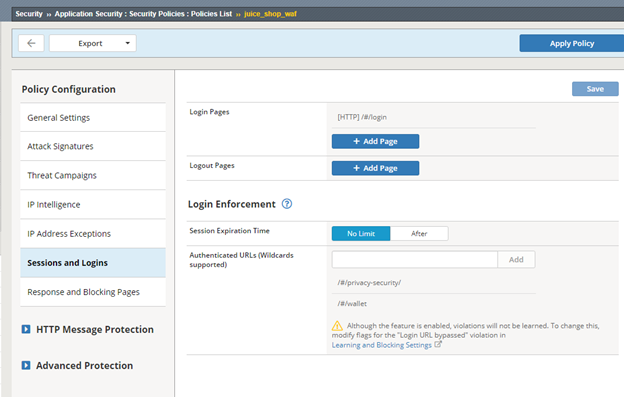
Source: F5
Application Security Testing
4. Checkmarx

Best for: Securing code across the SDLC from the IDE to runtime.
Strengths: Hybrid scanning, ASPM risk correlation, and in-IDE remediation.
Things to consider: False positives and slower scans on large codebases.
Checkmarx One is a cloud-native application security platform that combines multiple scanning engines with risk intelligence and AI-powered agents across the software development lifecycle. It brings together SAST, SCA, IaC security, API security, secrets detection, container security, malicious package protection, and DAST in one platform. A hybrid scanning engine combines deterministic rules with AI reasoning to identify vulnerabilities and rank them by exploitability.
Application Security Posture Management correlates findings across scanners and adds business context to produce a single prioritized view of risk. AI-powered agents, including Developer Assist and Triage and Remediation Assist, operate inside developer tools to detect issues and suggest fixes as code is written.
Key features include:
- Hybrid scanning engines: Combines deterministic rule-based detection with AI reasoning across SAST, SCA, IaC, API, secrets, container, and DAST engines to cover multiple attack surfaces in one platform.
- Application Security Posture Management: Correlates findings from all scanners and enriches them with business context to produce a single prioritized view of application risk ranked by exploitability.
- AI-powered security agents: Developer Assist detects and explains issues in the IDE, while Triage and Remediation Assist prioritizes risk and generates fix recommendations within developer workflows.
- Supply chain and AI coverage: Includes malicious package protection, container security, repository health, and an AI bill of materials for tracking AI components in the codebase.
- Developer toolchain integration: Plugs into IDEs such as VS Code, JetBrains, Visual Studio, and Eclipse, source control and CI/CD systems, and ticketing tools such as Jira, so scanning runs inside existing pipelines.
- Broad language and on-prem support: Covers a range of programming languages and frameworks and offers an on-premises SAST option alongside the cloud platform.
Limitations (as reported by users on PeerSpot):
- False positives: Users report that the SAST engine can produce a significant number of false positives that require manual triage.
- Scan speed and resource use: Some users report slow scan times and high memory use, particularly when checking large builds.
- Interface and learning curve: Navigation through the web interface can be slow, and new users face a learning curve due to the range of features.
- Pricing: Some users consider the pricing model expensive.
5. Snyk
Best for: Developer-first security for code, dependencies, containers and IaC.
Strengths: In-IDE and pull-request fixes with CI/CD integration.
Things to consider: False positives and cost can grow at scale.
Snyk is a developer security platform for securing custom code, open-source dependencies, containers, and infrastructure as code. Its products include Snyk Code for static analysis, Snyk Open Source for dependency scanning, Snyk Container for container images, Snyk IaC for infrastructure configuration, and Snyk API & Web for dynamic testing. The platform embeds into IDEs, source control, CI/CD pipelines, and AI coding assistants so that issues are found as code is written.
It provides one-click fixes in the IDE and pull requests, and uses risk scoring and reachability analysis to prioritize exploitable issues. Snyk also offers governance and analytics to enforce policies and track risk reduction across a program.
Key features include:
- Static analysis with Snyk Code: Scans custom code as it is written and provides fix guidance directly in the developer's environment to address vulnerabilities before code is merged.
- Open source and dependency scanning: Snyk Open Source identifies vulnerable and outdated dependencies and license risks, and can automatically open pull requests with fixes.
- Container and IaC security: Snyk Container scans base images for vulnerabilities, and Snyk IaC checks Kubernetes, Terraform, and other configurations for misconfigurations in code.
- Developer workflow integration: Integrates with IDEs, source control, CI/CD systems, registries, and AI coding assistants so security checks run inside existing tools.
- Risk-based prioritization: Uses risk scoring and reachability analysis to highlight exploitable issues, and provides one-click fixes in the IDE and pull requests.
- Governance and analytics: Provides policy enforcement and analytics to track risk reduction, developer adoption, and program-level reporting.
Limitations (as reported by users on PeerSpot):
- False positives: Users report false positives, including findings in code paths that are not exploitable in their implementation, which can increase over time on imported projects.
- Alert volume: Some users describe large numbers of low-severity findings that require effort to sort through, creating alert fatigue for smaller teams.
- Pricing: Users describe the platform as expensive, with advanced features and higher API access reserved for paid tiers.
- Documentation and integrations: Some users report gaps in documentation and challenges integrating with certain IDE plugins and CI tools.
6. Veracode

Best for: Enterprise application security testing across the SDLC.
Strengths: SAST, DAST, SCA, ASPM, and AI remediation in one platform.
Things to consider: Slower scans and an interface some users find dated.
Veracode is an application risk management platform that identifies, prioritizes, and helps remediate vulnerabilities across the software development lifecycle. It brings together static analysis (SAST), dynamic analysis (DAST), software composition analysis (SCA), container and IaC scanning, and a Package Firewall, with a Risk Manager module that provides Application Security Posture Management.
Its SAST engine analyzes code and integrates with developer tools to provide feedback during coding. The Fix capability uses AI trained on curated data to generate suggested patches for flaws. Veracode also offers penetration testing as a service and developer security training through eLearning and Security Labs.
Key features include:
- Static analysis (SAST): Analyzes code to find flaws during development, integrates with more than 40 developer tools, and provides feedback intended to reduce risk early in the lifecycle.
- Dynamic analysis (DAST): Identifies runtime vulnerabilities in web applications and APIs through simulated attacks against running applications.
- Software composition analysis: Scans open-source dependencies for known vulnerabilities and license risks and provides feedback and fixes within the pipeline.
- Risk Manager (ASPM): Provides unified visibility into application risk, identifies the owner and root cause of each issue, and recommends next actions for remediation.
- AI-powered remediation (Fix): Generates suggested patches from a curated set of reference fixes designed by Veracode experts to automate parts of flaw remediation.
- Package Firewall and container security: Blocks vulnerable or malicious packages before they enter pipelines and scans containers and infrastructure as code for vulnerabilities, misconfigurations, and embedded secrets.
Limitations (as reported by users on PeerSpot):
- Scan speed: Users report that source code scans can take significant time, which can slow fast-moving CI/CD pipelines.
- False positives: Users report high false-positive volumes, including flagging of test libraries and development dependencies, which adds triage effort.
- Interface: Users describe the interface as dated and cluttered, making navigation and finding settings harder for new users.
- Mitigation workflow: Addressing or mitigating flagged issues can require Veracode administrators, which can introduce delays.
まとめ
Application protection requires a layered approach that spans development, deployment, and runtime environments. As attack surfaces expand with cloud, APIs, and AI-driven systems, organizations must combine multiple security capabilities to maintain visibility and control. Integrating security into development workflows, leveraging automation, and applying consistent policies across environments are essential to reducing risk and responding effectively to evolving threats.