Summary: A WAF filters malicious HTTP/S traffic to protect web apps and APIs. Best for cloud-native protection: Radware Cloud WAF; for edge scale: Cloudflare; for AWS workloads: AWS WAF; for hybrid/on-prem: Imperva.
What is a Web Application Firewall (WAF)?
A Web application firewall (WAF) protects websites and web applications by monitoring, filtering, and blocking malicious HTTP/S traffic, defending against threats like SQL injection, cross-site scripting (XSS), other OWASP Top 10 vulnerabilities, and more recently, threats to AI applications, including prompt injection and sensitive data exfiltration. WAFs act as a specialized defense layer, inspecting traffic based on security rules to identify and block harmful requests before they reach the application, ensuring the integrity and security of the web service.
Positioned as a reverse proxy, a WAF inspects incoming and outgoing web traffic, enabling detection and mitigation of suspicious requests before they reach the web application(s). WAFs operate using a combination of predefined rules and dynamic analysis techniques to identify potentially harmful behavior or patterns.
WAFs can be deployed as hardware appliances, software solutions, or cloud-based services, offering flexible integration into a variety of infrastructures. The primary goal of a WAF is to ensure that only safe, properly structured requests make it to the application, protecting sensitive user data and business processes from exploitation.
Editor's note: This article has been updated to add recent WAF market data and WAF solutions to reflect features and capabilities in 2026.
In this article:
The table below summarizes the key differences between the web application firewalls covered in this article, including what each is best for and the trade-offs to weigh. We explore each solution in more detail in the sections that follow.
| Category |
ソリューション |
Best For |
Key Strengths |
Things to Consider |
| Cloud-Native WAF Services |
ラドウェアクラウドWAFサービス |
Cloud-based OWASP and zero-day protection for apps and APIs |
Automated policy generation with positive and negative security |
Customization and interface depth may feel limited to some users |
| Cloud-Native WAF Services |
Cloudflare WAF |
Edge-deployed protection with auto-updating managed rules |
Rapid network-wide rules and low-latency edge enforcement |
Some features limited to Enterprise plans; log retention |
| Cloud-Native WAF Services |
Barracuda Web Application Firewall |
Web, API, and mobile backend protection with app delivery |
Broad protection with load balancing and access controls |
Configuration interface seen as dated by some users |
| Cloud-Native WAF Services |
AWS WAF |
Protecting web applications running on Amazon Web Services |
Managed rules, bot control, and automatic layer 7 DDoS |
Payload inspection limits; basic native dashboards |
| Cloud-Native WAF Services |
Akamai App & API Protector |
Edge-delivered app, API, bot, and DDoS protection in one |
Adaptive engine with automated updates and self-tuning |
Configuration and reporting can require tuning effort |
| Enterprise & Hybrid WAF Platforms |
Imperva Web Application Firewall |
Hybrid and on-prem apps needing low false positives |
Managed rules and analytics with block-mode confidence |
Cost and SIEM/rule configuration can be involved |
| Enterprise & Hybrid WAF Platforms |
Fortinet FortiWeb |
Flexible-deployment WAF across hardware, VM, and cloud |
Dual-layer machine learning with bot and API defense |
Setup complexity and support response noted by users |
| Enterprise & Hybrid WAF Platforms |
F5 BIG-IP Advanced WAF |
On-prem and data-center apps needing granular policies |
Behavioral L7 DoS, API security, and in-browser encryption |
Complex configuration requiring expertise; cost |
Web applications are a frequent target for attackers because they often contain vulnerabilities that can be exploited to compromise sensitive data, disrupt services, or deface content. A breach at the application layer typically allows threat actors direct access to databases and internal resources, resulting in significant financial, operational, and reputational damage.
Traditional firewalls and network security devices are not equipped to inspect and understand application-layer traffic, leaving many modern threats undetected if a dedicated WAF is not in place. Organizations are compelled to deploy WAFs as they often face regulatory requirements regarding data protection and privacy, such as PCI DSS or GDPR.
Compliance aside, WAFs provide a proactive defense against known threats and zero-day vulnerabilities by applying rigorous traffic inspection, anomaly detection, and adaptive response mechanisms.
Related content: Read our guide to WAF cyber security.
The web application firewall market is expanding rapidly as organizations increase investment in application-layer security. The market was valued at USD 9.37 billion in 2025 and is expected to grow to USD 22.05 billion by 2031. This represents a compound annual growth rate (CAGR) of 14.9% between 2026 and 2031.
Growth is driven by rising attacks on web applications, the expansion of cloud-native infrastructure, and stricter global data protection regulations. As businesses rely more heavily on APIs, microservices, and cloud platforms, protecting application traffic has become a critical security requirement.
Adoption varies by industry based on risk exposure and regulatory pressure:
- The banking, financial services, and insurance (BFSI) sector represented 23.54% of WAF demand in 2025. Financial institutions face strict compliance standards and frequent attacks targeting payment systems and customer data.
- The healthcare sector is expected to grow the fastest, with a 15.68% CAGR through 2031. Updated HIPAA guidance requires stronger protections such as virtual patching and integration with security monitoring platforms, pushing hospitals and telemedicine providers to deploy WAF solutions.
- Large enterprises currently generate the majority of revenue, accounting for 61.56% of market spending in 2025. However, small and medium enterprises are rapidly adopting WAFs as cloud-based subscription pricing eliminates the need for expensive hardware deployments.
OWASP Top 10 and Application-Layer Attack Protection
The OWASP Top 10 outlines the most critical security risks to web applications, including SQL injection, cross-site scripting, and insecure deserialization. Modern WAFs offer native protection against these prevalent threats by inspecting incoming HTTP/S requests and blocking attacks before they can exploit application vulnerabilities.
Beyond basic blocking, WAFs provide real-time visibility and logging of attempted attacks, assisting security teams in understanding threat patterns and reinforcing weak spots. This detailed insight allows organizations to prioritize remediation efforts according to real-world risks and adapt their security policies in response to emerging threats.
Deep HTTP/S Traffic Inspection
Deep HTTP/S inspection enables a WAF to analyze application traffic at a granular level, inspecting full request and response payloads rather than just headers. This capability is crucial for identifying complex, obfuscated, or multi-stage attacks that may bypass simpler filtering mechanisms. By thoroughly examining HTTP/S data, a WAF can enforce strict security policies.
The inspection process often includes decoding encoded payloads, scrutinizing embedded scripts, and validating request structure against application expectations. This level of scrutiny ensures that malicious content or data exfiltration attempts are caught early, while legitimate user interactions remain unaffected.
Signature-based + Behavior/ Anomaly Detection
Signature-based detection leverages known attack patterns and rule sets to identify and block threats, effective for defending against common exploits that have been previously cataloged. However, attackers frequently vary their techniques to circumvent these rules. To address this, WAFs also employ behavioral and anomaly detection, continuously learning normal traffic patterns and flagging deviations that may indicate novel attacks or suspicious behavior.
This combination of methods significantly strengthens a WAF's defensive capability, providing coverage against both established threats and new, emerging tactics. By correlating multiple detection approaches, WAFs minimize false negatives, adapt to evolving threat landscapes, and offer actionable intelligence for swift incident response.
Virtual Patching
Virtual patching is the process of mitigating vulnerabilities at the WAF layer, often before the underlying application code can be updated. When a new vulnerability is discovered, a virtual patch can be created quickly to block specific exploit methods, buying valuable time for development teams to perform permanent code fixes.
By implementing virtual patches, organizations reduce their attack surface and likelihood of exploitation, even during periods between vulnerability disclosure and actual remediation. This also helps organizations maintain compliance with regulatory standards, as virtual patches can be documented as compensating controls for known risks in audit scenarios.
Bot and Automated Attack Mitigation
Malicious bots conduct a range of automated attacks, including credential stuffing, scraping, vulnerability scanning, and denial-of-service attacks. WAFs are equipped with mechanisms to detect and mitigate these threats, often through device fingerprinting, CAPTCHA challenges, analysis of request patterns, and rate limiting. This helps in distinguishing legitimate users from automated, potentially harmful traffic.
Effective bot mitigation protects not only the application's availability and performance but also protects business data and user privacy. As bots become more sophisticated, leveraging headless browsers and mimicking human behavior, advanced WAFs continuously update their algorithms and blocking techniques.
DDoS and Rate Limiting
Distributed Denial of Service (DDoS) attacks aim to overwhelm web applications with massive traffic, rendering them inaccessible to legitimate users. WAFs defend against DDoS by employing a combination of high-capacity filtering, source validation, geo-blocking, and real-time traffic analysis to dissipate attack traffic. They do this without impacting genuine requests, ensuring business continuity during volumetric or application-layer attacks.
Rate limiting further enforces security by restricting the number of requests an entity can make within a certain timeframe. This hampers brute force login attempts, API abuse, or resource-intensive spam activity.
SSL/TLS Support
Modern web applications rely heavily on SSL/TLS encryption to protect data as it travels between clients and servers. For effective inspection and defense, a WAF must support decryption and re-encryption of SSL/TLS traffic. This allows it to analyze secure payloads for threats that may be hidden within encrypted sessions, which would otherwise evade detection by traditional security tools.
SSL/TLS support in a WAF also enforces strong encryption policies, ensures the application uses up-to-date ciphers, and can help prevent protocol downgrade attacks. Properly managed, this feature ensures that sensitive information is not only transmitted securely but also scrutinized for anomalies or exploits without compromising user privacy or data integrity.
API防御
Automated API discovery plus schema- and business-logic enforcement are now core WAF capabilities: modern WAF/WAAP solutions continuously discover and catalog API endpoints, validate requests against API schemas (a positive-security model), and apply behavioral learning to detect token manipulation, parameter tampering, business-logic abuse and API-targeted bots or account-takeover attempts. These controls let a WAF block API-specific abuse (including scraping, credential stuffing and malformed/invalid payloads) in real time while reducing false positives through learned business-logic context.
顧客側環境の保護
Protection that extends into the browser monitors and hardens the client-side attack surface by mapping and continuously monitoring third-party scripts and browser-side supply-chain components, detecting risky or malicious changes and preventing data exfiltration from the user's browser. When combined with server-side WAF controls and bot management, client-side protections provide end-to-end coverage for sensitive user data (payment and PII) that attackers try to harvest via injected/skimmer scripts or compromised third-party resources.
AI Firewall
As organizations increasingly deploy AI-powered applications, especially those based on large language models (LLMs), new categories of threats have emerged that traditional WAFs are not equipped to handle. AI firewalls extend WAF capabilities to protect generative AI interfaces from attacks like prompt injection, model manipulation, sensitive data exfiltration, and abuse of AI-powered endpoints.
AI firewalls operate by inspecting prompts, outputs, and metadata associated with AI interactions. They apply policies that detect malicious patterns, such as attempts to override system instructions, leak training data, or extract confidential information via multi-turn conversations. This inspection often includes context-aware filtering and user behavior modeling to prevent subtle exploit chains from succeeding.
In addition to prompt-layer defenses, AI firewalls provide rate limiting, abuse detection, and user authentication tailored for AI APIs and chat interfaces. They help organizations enforce business-specific constraints, prevent model misuse, and maintain regulatory compliance in environments where LLMs process customer data, financial records, or proprietary IP. These tools are critical for safely operationalizing generative AI in customer-facing or high-risk use cases.
How we selected these tools: We shortlisted web application firewalls based on their protection against OWASP Top 10 and application-layer attacks, bot and DDoS mitigation, API security, deployment flexibility across cloud and on-premises environments, and the depth of their managed rules and threat intelligence.
Cloud-Native WAF Services
1. Radware Cloud WAF Service

Best for: Cloud-based OWASP and zero-day protection for apps and APIs
Strengths: Automated policy generation with positive and negative security
Things to consider: Customization and interface depth may feel limited to some users
Radware Cloud WAF Service is a cloud-delivered web application firewall that protects web applications and APIs as part of Radware's Cloud Application Protection Services. It combines a negative security model with an AI-powered behavioral positive security model to block traffic that deviates from legitimate application behavior. The service automatically learns how applications behave, maps protected applications, and detects code changes so that security policies can be adapted over time.
It covers OWASP Top 10 attacks and mitigates zero-day attacks, and runs across a global network of points of presence (PoPs) positioned close to servers. It is delivered as a managed service with emergency response support, and can be deployed across virtual, public, multi-cloud, hybrid, on-premises, and Kubernetes environments.
Key features include:
- Auto traffic learning and application mapping: Analyzes traffic to learn legitimate application behavior, automatically maps protected applications, detects code changes, and identifies potential vulnerabilities so protection adjusts as applications change.
- Adaptive security policies: Continuously and automatically adapts security policies to current threat profiles, with the stated aim of maintaining protection while reducing false positives across evolving applications.
- Combined positive and negative security: Pairs a signature-based negative security model with an AI-powered behavioral positive security model to block OWASP Top 10 threats, vulnerability exploits, and zero-day attacks.
- Bot and account takeover protection: Filters bot traffic across websites, mobile apps, and APIs using device fingerprinting, addressing credential stuffing, scraping, and account takeover attempts.
- API and business logic protection: Discovers APIs, learns business logic from runtime traffic, generates tailored policies, and blocks API-focused attacks, unauthorized API use, and abuse of application workflows.
- Application-layer DDoS and client-side protection: Provides behavioral detection and mitigation for HTTP and Web DDoS attacks across layers 3 to 7, and helps protect users from browser-side supply chain attacks while supporting data leakage prevention.
- Automated analytics and cross-module correlation: Consolidates alerts into manageable user activities and uses AI to correlate threats across security modules into a broader attack story.
Limitations (as reported by users on G2):
- Pricing scope: Depending on traffic volume, number of applications, and contracted bandwidth, costs can be higher than some alternatives.
- Customization depth: Some users would like more flexibility to tailor the interface and certain configurations.
- Interface responsiveness: A small number of users note the interface can feel slow when working with larger datasets.
2. Cloudflare WAF

Best for: Edge-deployed protection with auto-updating managed rules
Strengths: Rapid network-wide rules and low-latency edge enforcement
Things to consider: Some features limited to Enterprise plans; log retention
Cloudflare WAF is a cloud-based web application firewall that operates at the edge of Cloudflare's global network, inspecting HTTP/S requests before they reach the application. It uses managed and custom rules to identify and block malicious payloads, covering common exploits such as SQL injection and cross-site scripting as well as zero-day vulnerabilities.
Because the WAF is deployed across the entire network, protection is enforced close to the user. When a new vulnerability emerges, Cloudflare's security team can write and deploy a rule across the network, and managed rulesets are run against large volumes of traffic to tune them. The WAF is fully managed via API, allowing it to be integrated into CI/CD workflows.
Key features include:
- OWASP Top 10 protection: Blocks OWASP Top 10 vulnerabilities such as SQL injection and cross-site scripting that target web applications and APIs, using managed rulesets run against large traffic volumes.
- Virtual patching for CVEs: When a CVE is announced for a library or framework, the WAF can block exploits targeting that specific CVE before the developer patches their own code.
- Automated security updates: Auto-updating security rules draw on the scale and intelligence of the network to protect against emerging threats without manual intervention.
- Managed and custom rulesets: Combines predefined managed protections with configurable custom rules so organizations can enforce their own policies alongside Cloudflare's.
- Inline content scanning: File-upload endpoints can be routed through WAF content scanning, exposing fields that allow dangerous files to be quarantined or rewritten on the fly.
- Edge-based enforcement: The WAF runs across Cloudflare's global infrastructure, applying inspection at the edge close to users with minimal added latency.
Limitations (as reported by users on G2):
- Configuration learning curve: Managing complex firewall rules and WAF configurations can be challenging for those less familiar with networking.
- Plan-tiered features: Some specialized capabilities, such as advanced bot management, are only available on Enterprise plans.
- Log retention and export: Users report friction around log retention and exporting log data for longer-term analysis.
- Occasional false positives: Bot mitigation can occasionally flag legitimate users or scripts, requiring manual adjustment and whitelisting.
- DNS dependency: Operating as a reverse proxy requires pointing DNS to Cloudflare, which can complicate migration or troubleshooting.
3. Barracuda Web Application Firewall

Best for: Web, API, and mobile backend protection with app delivery
Strengths: Broad protection with load balancing and access controls
Things to consider: Configuration interface seen as dated by some users
Barracuda Web Application Firewall protects web applications, APIs, and mobile app backends against attacks including the OWASP Top 10, zero-day threats, data leakage, and application-layer denial-of-service attacks. It is part of Barracuda Cloud Application Protection, an integrated platform of application security capabilities, and combines signature-based policies and a positive security model with anomaly-detection capabilities.
It is available with flexible deployment options and includes an application delivery module that adds HTTP load balancing, content routing, caching, and compression. A full REST API supports automation and integration with DevOps tools, and the product integrates with vulnerability scanning and SIEM systems.
Key features include:
- OWASP and DDoS protection: Combines signature-based policies, positive security, and anomaly detection to block OWASP Top 10 attacks; Barracuda Active DDoS Prevention is an add-on that filters volumetric attacks before they reach the network.
- Advanced bot protection: Uses machine learning to distinguish legitimate human and bot traffic from malicious and human-mimicking bots while allowing legitimate traffic through.
- API and mobile app protection: Secures REST and WSDL interfaces with XML protection, scans JSON payloads, and uses API Discovery to automatically create rulesets from API definition files.
- Access control and authentication: Integrates with AD, LDAP, and RADIUS, supports SAML single sign-on, and adds two-factor authentication through integrations such as RSA SecurID and Duo.
- Application delivery and SSL/TLS: Includes a hardened SSL/TLS stack with pre-built templates for compliant ciphers, plus HTTP load balancing, content routing, caching, and compression.
- Automation and visibility: Integrates via REST API with Puppet, Chef, Ansible, Terraform, Azure ARM, and AWS CloudFormation, and feeds dashboards and external SIEMs such as Azure Sentinel, Splunk, and IBM QRadar.
Limitations (as reported by users on G2):
- Dated configuration interface: The configuration interface is described as not intuitive and largely unchanged over many years.
- Detection and false positives: Some users report false positives and weaker attack identification and logging compared with competing products.
- Documentation depth: Limited documentation can require significant in-house IT knowledge for implementation and ongoing operation.
- WAF-as-a-Service pricing: Some users would like more affordable WAF-as-a-Service options.
4. AWS WAF

Best for: Protecting web applications running on Amazon Web Services
Strengths: Managed rules, bot control, and automatic layer 7 DDoS
Things to consider: Payload inspection limits; basic native dashboards
AWS WAF is a web application firewall from Amazon Web Services that lets users create security rules to control bot traffic and block common attack patterns such as SQL injection and cross-site scripting. It provides managed rules so teams spend less time building protections from scratch, and a consolidated interface that AWS states reduces security deployment configuration steps.
Preconfigured protection packs provide templates for specific workload types such as APIs, PHP applications, and web services. The service can filter web requests based on conditions such as IP addresses, HTTP headers and body, or custom URIs, and integrates with other AWS services.
Key features include:
- Managed rules: Provides prebuilt, maintained rule sets so teams can apply protections without writing every rule themselves, reducing setup time.
- Bot traffic control: Monitors, blocks, or rate-limits common bot traffic, and can collect payments from AI bots and agents accessing content and APIs via Coinbase's x402 Facilitator.
- Automatic layer 7 DDoS protection: Continuously monitors and automatically mitigates application-layer (layer 7) DDoS events within seconds.
- Account takeover and fraud prevention: Monitors login pages for unauthorized access using compromised credentials and signup pages for fake account creation by bots or disposable email addresses.
- Custom traffic filtering rules: Lets users build rules to filter web requests based on IP addresses, HTTP headers and body, or custom URIs.
- Protection packs and consolidated visibility: Preconfigured protection packs deliver templates for specific industries and workloads, combined with a single interface for security visibility and ongoing recommendations.
Limitations (as reported by users on G2):
- Payload inspection limits: A body inspection limit and a capacity (WCU) cap can leave larger payloads uninspected or force trade-offs on inspection depth.
- Basic native dashboards: Native dashboards are limited, with paid CloudWatch/S3 logging and manual queries needed to visualize traffic and tune false positives.
- Configuration complexity: Initial configuration can be complex, and costs can rise with increased usage.
- Caching efficiency: Some users note it does not match the static-content caching efficiency of certain edge-based competitors.
5. Akamai App & API Protector

Best for: Edge-delivered app, API, bot, and DDoS protection in one
Strengths: Adaptive engine with automated updates and self-tuning
Things to consider: Configuration and reporting can require tuning effort
Akamai App & API Protector is a web application firewall delivered from Akamai's edge platform that combines application and API protections in a single solution. It is built around the Adaptive Security Engine, which learns attack patterns and adapts protections to new threats, inspecting each request in real time to defend against web application and API attacks, DDoS, and malicious bots.
The solution provides Akamai-managed updates and machine learning–powered self-tuning to reduce manual effort. It includes API discovery and a Behavioral DDoS Engine for layer 7 protection, and App & API Protector Hybrid extends WAF protection beyond the CDN into on-premises, hybrid cloud, and multi-CDN environments.
Key features include:
- Adaptive Security Engine: Learns attack patterns and adapts protections to evolving threats, including zero-days and CVEs, defending against OWASP Top 10 and API exploits.
- All-in-one protection: Combines the WAF with layer 7 DDoS defense, API discovery, sensitive data protection, and bot controls within one solution.
- Automated updates and self-tuning: Pushes the latest app and API defenses automatically and uses machine learning to self-tune, reducing manual rule updates and policy tuning.
- Behavioral DDoS Engine: Provides a suite of layer 7 capabilities to automatically detect and mitigate sophisticated application-layer DDoS attacks.
- Hybrid coverage: App & API Protector Hybrid extends WAF protections off the Akamai edge to secure north-south and east-west traffic across on-prem, hybrid cloud, and multi-CDN environments.
- DevOps integration and malware scanning: Offers an open API, CLI, and Terraform provider for CI/CD pipelines, plus an edge malware-protection module that scans files before they reach the origin.
Limitations (as reported by users on G2):
- Configuration and monitoring complexity: Managing configurations and monitoring can be complex, and configuration changes can be subject to delays.
- Custom rules and reporting: Custom rule creation and analytics reporting could be improved for better visibility in the console.
- False positive tuning: Policy tuning and false-positive management can be time-consuming, especially during initial deployment.
- Documentation: Some users report documentation that is outdated in places.
6. Imperva Web Application Firewall

Best for: Hybrid and on-prem apps needing low false positives
Strengths: Managed rules and analytics with block-mode confidence
Things to consider: Cost and SIEM/rule configuration can be involved
Imperva Web Application Firewall protects web applications and APIs across cloud, on-premises, and hybrid environments. Its managed rules are written and tested in production by the Imperva Threat Research team before deployment, which the vendor states allows most customers to run in blocking mode. The product uses machine learning through its Attack Analytics capability to correlate security events into incident narratives, reducing alert volume.
It supports flexible deployment through Cloud WAF (SaaS), WAF Gateway (for legacy and data-sovereignty needs), and Elastic WAF (Kubernetes-based), and includes enterprise SSL management and infrastructure-as-code deployment via a Terraform provider.
Key features include:
- Managed rules and threat research: The Imperva Threat Research team continuously creates and tests rules in production and pushes them to customers, providing updated protection without manual rule creation.
- Low false-positive blocking: High detection accuracy is intended to let organizations run in blocking mode with minimal disruption to legitimate traffic.
- Attack Analytics: Uses machine learning to correlate thousands of security alerts into narratives with context such as attack origin, method, and severity, reducing alert fatigue.
- Flexible deployment options: Offers Cloud WAF (SaaS), WAF Gateway for legacy or data-sovereignty requirements, and Elastic WAF for Kubernetes and cloud-native environments.
- Malicious file upload protection: Upload Scan and Control validates, scans, and controls uploaded files before they reach application backends to reduce malware and exfiltration risk.
- Enterprise SSL and automated deployment: Manages SSL certificate lifecycle and encrypted traffic, and automates deployment and configuration through a Terraform provider.
Limitations (as reported by users on G2):
- Cost: The cost of implementing and maintaining the WAF is noted by some users as a drawback.
- SIEM and configuration depth: Audit logging to SIEM can be challenging to configure, and many options can make deeper setup hard to navigate.
- Rule effectiveness and guidance: Some users report that newly created rules do not always work as intended and find guidance unclear for rules and IP allow/deny lists.
- Default settings: Some default values may require review before production to avoid weakened protection.
7. Fortinet FortiWeb

Best for: Flexible-deployment WAF across hardware, VM, and cloud
Strengths: Dual-layer machine learning with bot and API defense
Things to consider: Setup complexity and support response noted by users
Fortinet FortiWeb is a web application firewall that protects web applications and APIs against known and unknown threats, including AI-generated zero-day attacks. It uses a dual-layer machine learning approach to model each application, identify malicious patterns, and reduce false positives. FortiWeb includes anomaly detection, API discovery and protection, bot mitigation, and client-side security, and applies AI for zero-day detection, threat analytics, and a built-in SOC agent.
It integrates with the Fortinet Security Fabric, including FortiGate firewalls and FortiSandbox. The product is available in multiple form factors including hardware appliances, virtual machines, containers, and SaaS, and is offered in major public cloud marketplaces.
Key features include:
- Dual-layer machine learning detection: Applies machine learning to model each application, detecting and mitigating known and zero-day attacks while minimizing false positives.
- Bot mitigation: Uses techniques such as bot deception, biometric detection, and machine learning to identify and manage malicious bots while allowing legitimate bots, without relying heavily on CAPTCHAs.
- API discovery and protection: Continuously evaluates traffic to automatically discover APIs and generates positive security model policies for each schema specification (OpenAPI, XML, JSON).
- Client-side protection: Detects and mitigates third-party script injections, DOM manipulation, and form hijacking in the browser, addressing a PCI DSS requirement to monitor scripts on payment pages.
- Security Fabric integration and analytics: Integrates with FortiGate NGFWs and FortiSandbox against advanced persistent threats and provides analytics and playbooks, with FortiAI-Assist for forensics.
- Flexible form factors: Available as hardware appliances, virtual machines, containers, and SaaS, with hardware-based acceleration for WAF throughput and SSL processing.
Limitations (as reported by users on G2):
- Scalability and high availability: Some high-availability and scalability needs can require additional hardware investment.
- Support and integration: Users cite slower support response times and complexity integrating with some third-party technologies.
- Performance under load: Application performance can occasionally slow when handling high traffic volumes or complex rule sets.
- Initial setup: Initial setup can be complex for users new to the product.
8. F5 BIG-IP Advanced WAF

Best for: On-prem and data-center apps needing granular policies
Strengths: Behavioral L7 DoS, API security, and in-browser encryption
Things to consider: Complex configuration requiring expertise; cost
F5 provides web application firewalls across multiple deployment models, with BIG-IP Advanced WAF aimed at on-premises, data center, software, and public cloud deployments. BIG-IP Advanced WAF combines machine learning, threat intelligence, and application expertise to identify and block attacks, and provides guided configurations, a learning engine, and granular security policies for microservices and APIs.
It defends against the OWASP Top 10 and offers behavioral layer 7 DoS detection and mitigation, application-layer encryption of sensitive data in the browser, and protection against attacks that use stolen credentials. F5's broader WAF portfolio also includes Distributed Cloud WAF (SaaS), F5 WAF for NGINX (lightweight and containerized), and managed service options, so policies can be applied across edge, cloud, data center, and container environments.
Key features include:
- OWASP Top 10 defense with guided configuration: Provides a dynamic dashboard for OWASP Top 10 compliance, guided configurations for common use cases, and customized policy building through a learning engine.
- Behavioral layer 7 DoS protection: Uses behavioral analytics and machine learning to detect and mitigate application-layer denial-of-service attacks.
- API protocol security: Includes tools to secure GraphQL, REST/JSON, XML, and GWT APIs, and adds protection for Model Context Protocol (MCP) traffic used by agentic AI.
- In-browser data encryption: Encrypts data at the application layer to protect against data-extracting malware and man-in-the-browser attacks.
- Stolen credential and bot defense: Protects against brute-force attacks that use stolen credentials and provides proactive bot defense against automated tools.
- Security as code and flexible deployment: Supports declarative, API-based deployment and configuration, and runs as software on hypervisors, on supported public clouds, or on dedicated hardware.
Limitations (as reported by users on G2):
- Configuration complexity: The configuration interface is described as complex, and effective use requires deep product knowledge.
- Cost: Pricing is described as high, positioning it more toward larger enterprises.
- Maintenance and updates: Some users report issues with operating-system stability and updates that can revert configurations.
- User interface: The interface is seen as an area that could be made more user-friendly.
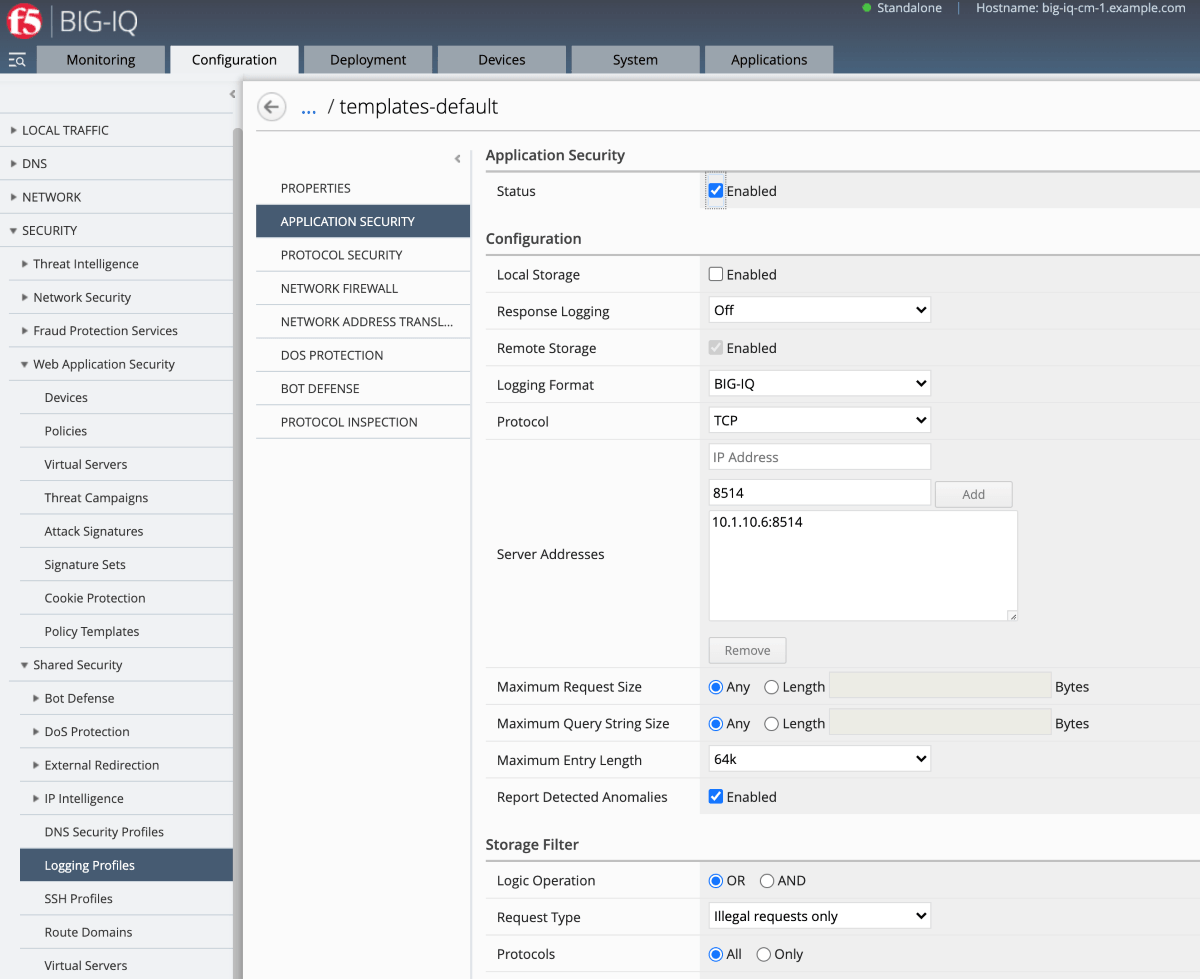
Source: F5
まとめ
Web application firewalls have become essential for securing websites against a growing array of sophisticated threats targeting the application layer. Their ability to block injection attacks, mitigate bot abuse, enforce rate limits, and inspect encrypted traffic ensures that both legacy and modern web applications remain secure and available. Effective WAFs also reduce the time to respond to zero-day vulnerabilities through features like virtual patching and adaptive threat detection.