Summary: Web application firewalls (WAFs) filter and block malicious traffic to protect apps and APIs. Best picks: Radware Cloud WAF for automated managed protection, Cloudflare for edge scale, Imperva for low false positives, and F5 for flexible deployment.
What is a Web Application Firewall?
A Web Application Firewall (WAF) is a security solution designed to monitor, filter, and block HTTP(S) traffic to and from a web application. Unlike traditional firewalls that protect network perimeters, WAFs specifically focus on guarding web applications against threats such as SQL injection, cross-site scripting (XSS), and other application-layer attacks.
Reliable web application firewalls (WAFs) include solutions like Radware Cloud WAF, Cloudflare WAF, and Imperva Cloud WAF. These solutions are known for their machine learning capabilities, integration with cloud platforms, and robust protection against common web attacks like SQL injection and Cross-Site Scripting (XSS). The best choice depends on factors such as the existing cloud infrastructure, budget, and the need for advanced customization.
WAFs operate by enforcing rulesets or signatures that identify known attack patterns and anomalous behaviors. Many modern WAFs also incorporate machine learning algorithms to adaptively detect new threats. By blocking malicious traffic before it reaches web servers, WAFs help maintain application availability and integrity, protect sensitive data, and ensure compliance with security standards such as PCI DSS.
In this article:
The table below summarizes the key differences between the web application firewalls covered in this guide. We explore each solution in more detail in the sections that follow.
| Category |
ソリューション |
Best For |
Key Strengths |
Things to Consider |
| Cloud-Delivered WAF Services |
Radware Cloud WAF |
Automated, managed app and API protection |
AI behavioral policies; low false positives |
Setup and tuning need expertise |
| Cloud-Delivered WAF Services |
Cloudflare WAF |
Edge-delivered protection at scale |
Fast zero-day rules; global network |
Pricing and support tiers |
| Cloud-Delivered WAF Services |
Imperva Cloud WAF |
Confident blocking in production |
Production-tested managed rules |
Interface and config complexity |
| Cloud-Delivered WAF Services |
Akamai App & API Protector |
Apps and APIs across edge/cloud/hybrid |
Self-tuning, all-in-one defense |
Premium pricing |
| Cloud-Delivered WAF Services |
AWS WAF |
AWS-centric environments |
Native AWS integration; managed rules |
Billing and rule complexity |
| Appliance & Enterprise WAFs |
F5 BIG-IP Advanced WAF |
Flexible hardware, virtual or cloud |
Granular policies; L7 DoS; API security |
Needs expert tuning |
| Appliance & Enterprise WAFs |
Fortinet FortiWeb |
Fortinet Security Fabric users |
Dual-layer ML; hardware acceleration |
Inconsistent support; tuning effort |
| Appliance & Enterprise WAFs |
Barracuda Web Application Firewall |
Mid-market simplicity |
Bot defense, access control, app delivery |
Dated UI; support concerns |
The global Web Application Firewall (WAF) market is expected to grow from USD 10.13 billion to approximately USD 30.86 billion by 2034, representing a compound annual growth rate (CAGR) of 14.90%.
North America currently leads the market, holding 36.10% of the global share. This growth is driven by increasing demand for web application security as organizations expand their digital services and move more workloads to the cloud.
Market Trends
A key trend in the WAF market is the growing adoption of cloud-based WAF solutions. Cloud WAFs offer flexible deployment, easier management, and lower infrastructure costs compared to traditional on-premise options.
Cloud-based WAF platforms often include integrated security capabilities such as:
- Threat intelligence feeds
- Bot detection and mitigation
- Distributed denial-of-service (DDoS) protection
- API security
- Malware and phishing protection
Because these capabilities can be delivered as managed services, cloud WAFs allow organizations to protect applications even when users are not connected to internal networks or VPNs.
Market Segmentation
The WAF market can be categorized by deployment type and enterprise size.
By deployment model, the market includes:
- Network-based WAFs
- Host-based WAFs
- Cloud-based WAFs
Among these, the cloud segment is projected to dominate, expected to account for about 54.58% of the market. Cloud WAF solutions provide scalable protection and integrate easily with modern cloud-native architectures.
1. Detection Accuracy and False Positive Rates
Detection accuracy remains a cornerstone of WAF reliability. The ability of a WAF to identify genuine attacks without missing threats is essential for effective protection. Poor accuracy can lead to vulnerabilities being exploited or legitimate traffic being blocked. Advanced WAFs use multiple detection techniques, such as signature-based filtering, behavioral analysis, and anomaly detection, to enhance precision.
False positives, where legitimate activity is flagged as malicious, are a persistent challenge. Excessive false positives can disrupt business operations and frustrate users, while eroding trust in the security team. Modern WAFs employ more granular, context-aware rules and machine learning to reduce false positive rates.
2. Latency and Performance Overhead
Latency introduced by a WAF can affect user experience, especially for high-traffic web applications where millisecond delays impact performance metrics and customer satisfaction. As WAFs intercept and analyze each request, there is an unavoidable processing overhead. Efficient WAFs are designed to perform rapid analysis with minimal impact on response times, utilizing optimized inspection engines and hardware acceleration where possible.
Performance overhead must be tested during real-world peak conditions, not just under laboratory scenarios. Some WAFs provide features to bypass inspection for trusted endpoints or static assets, further optimizing throughput. The goal is to provide robust protection without degrading the speed and responsiveness expected by application users.
3. Scalability for High-Traffic Environments
Web applications serving thousands or millions of concurrent users demand a WAF that can scale horizontally and vertically. Scalability ensures the solution can handle surges in legitimate user traffic without compromising protection or performance. Leading WAFs support auto-scaling in cloud environments, leveraging load balancing and edge deployments to distribute inspection tasks efficiently across multiple nodes.
Manual interventions for scaling are increasingly inadequate. Enterprises require solutions that adapt dynamically to fluctuating loads while maintaining central management and configuration consistency. Cloud-native WAFs or appliances with elastic scaling capabilities are well-suited for eCommerce, SaaS, and large enterprise portals where traffic patterns are unpredictable.
4. High Availability and Redundancy
High availability is a prerequisite for WAFs deployed in mission-critical environments. WAF downtime can lead to exposure from unfiltered attacks or even block access to web applications entirely. Redundancy mechanisms, such as clustering, failover capabilities, and multi-region deployments, ensure that WAF protection remains continuous in the face of hardware failures, software issues, or connectivity outages.
Modern WAFs may be deployed in active-active or active-passive configurations to support seamless failover. Regular testing of disaster recovery and failover processes is necessary to verify actual resilience. For cloud WAFs, cross-region replication and load-balanced global points of presence boost availability.
5. Ease of Integration with Existing Infrastructure
Seamless integration with existing application delivery and security infrastructure is essential for the reliable operation of a WAF. Compatibility with load balancers, content delivery networks (CDNs), identity providers, and orchestration tools accelerates deployment and reduces configuration errors. APIs, automation, and support for popular DevOps workflows help integrate WAFs into CI/CD pipelines for real-time security enforcement.
Integration also includes interoperability with log management, SIEM, and incident response platforms for consolidated threat visibility and rapid event triage. The ability to support hybrid and multi-cloud architectures, where applications span on-premises data centers and public clouds, is crucial for modern enterprises.
Related content: Read our guide to WAF rules.
How we selected these tools: We shortlisted web application firewalls based on their ability to detect and block OWASP Top 10 and zero-day attacks, mitigate bots and DDoS, secure APIs, and integrate across cloud, hybrid, and on-premises environments.
Cloud-Delivered WAF Services
1. Radware Cloud WAF

Best for: Teams wanting automated, managed app and API protection
Strengths: AI behavioral policies that reduce false positives
Things to consider: Setup and policy tuning can require specialist skills
Radware Cloud WAF is a cloud-delivered web application firewall that protects applications and APIs and is offered as part of Radware’s Cloud Application Protection Service. It combines a negative security model based on signatures with an AI-powered, behavioral positive security model that learns the legitimate behavior of each application. This approach lets the service block traffic that deviates from normal patterns while limiting false positives.
The service stops OWASP Top 10 attacks and mitigates zero-day threats, and it adds built-in DDoS, API, bot, account takeover, and client-side protection across Layers 3 to 7. It can be deployed across virtual, public, multi-cloud, hybrid, on-premises, and Kubernetes environments, using a global network of points of presence and the SecurePath architecture to keep latency low without route changes or SSL key sharing.
Key features include:
- Automated traffic learning: Analyzes incoming traffic, learns legitimate application behavior, and blocks malicious activity. This underpins the behavioral positive security model that the service uses to reduce false positives over time.
- Application mapping: Automatically maps protected applications, detects code changes, and identifies potential vulnerabilities. The mapping keeps protection aligned with applications as they are updated and expanded.
- Adaptive security policies: Continuously adapts security policies to optimize threat profiles for each application. The goal is to maintain strong protection while lowering false positives without constant manual tuning.
- Multi-layered threat coverage: Combines OWASP Top 10 and zero-day protection with built-in DDoS mitigation, API protection, bot mitigation, account takeover protection, and client-side protection. This covers attacks across Layers 3 to 7 in a single service.
- Auto cross-module correlation: Uses AI to analyze threats detected across different security modules, compile a broader attack story, and preemptively block malicious sources. Automated analytics also consolidate alerts into manageable activities for administrators.
- Flexible deployment and managed service: Supports virtual, public, multi-cloud, hybrid, on-premises, and Kubernetes deployments backed by a managed service and emergency response team. A global network of points of presence keeps inspection close to application servers.
Limitations (as reported by users on G2):
- Reporting flexibility: Some users would like more customization and depth in the dashboards and reports, and at times export data for tailored views.
- Onboarding effort: A number of reviewers note that initial setup and policy fine-tuning benefit from experienced resources and can take time to complete.
- Third-party integration: A few users would like tighter and more seamless integration with external SIEM and reporting tools.
2. Cloudflare WAF

Best for: Edge-delivered protection with minimal added latency
Strengths: Rapid zero-day rule deployment across a global network
Things to consider: Pricing and support tiers can limit smaller teams
Cloudflare WAF inspects HTTP/S requests at the edge using managed and custom rulesets, blocking malicious payloads before they reach the application. It protects web applications and APIs from common and zero-day exploits such as SQL injection and cross-site scripting, and it is deployed across Cloudflare’s global network so enforcement happens close to users with minimal added latency.
The WAF is fully managed via API and fits into CI/CD workflows, and its managed rulesets are tuned against large, diverse traffic volumes to keep false positives low. When a new vulnerability emerges, Cloudflare’s security team can write and deploy a rule across the network quickly, helping protect customers before they patch their own code.
Key features include:
- OWASP Top 10 protection: Blocks the OWASP Top 10 vulnerabilities, such as SQL injection and cross-site scripting, that target web applications and APIs. Managed rulesets provide baseline coverage that can be extended with custom rules.
- Virtual patching for CVEs: When a CVE is announced for a library or framework, the WAF blocks exploits targeting that specific CVE. This gives teams time to patch their own code without leaving the application exposed.
- Managed and automated rule updates: Provides auto-updating security rules that protect against emerging threats without manual intervention. Rules are run against massive traffic volumes so they can be fine-tuned to reduce blocking of legitimate users.
- Inline content scanning: Routes file-upload endpoints through content scanning so dangerous files can be quarantined or rewritten on the fly. This adds a malware-gateway layer to standard request filtering.
- Edge architecture and performance: Runs across Cloudflare’s entire global network so protection is enforced near the user, adding little latency. The distributed model also improves resilience during large-scale attacks.
- Integrated DDoS, rate limiting, and bot management: Works alongside Cloudflare DDoS protection, rate limiting, and bot management. These adjacent services apply rate controls and distinguish benign from malicious automated traffic.
Limitations (as reported by users on G2):
- Pricing and billing clarity: Users report that pricing and billing can be confusing, with unexpected charges and subscriptions that are difficult to cancel.
- Support responsiveness: Reviewers on lower tiers describe slow ticket responses and limited direct support channels, including during urgent incidents.
- Configuration complexity: Setting up WAF rules and bot management is described as having a learning curve, particularly for non-networking users.
- Tiered feature access: Some advanced security and performance capabilities are only available on higher-priced plans.
3. Imperva Cloud WAF

Best for: Organizations needing confident blocking with few false positives
Strengths: Managed rules tested in production before release
Things to consider: Interface and policy configuration can be complex
Imperva Cloud WAF (part of Thales) protects applications and APIs across cloud, on-premises, and hybrid environments. It combines machine learning, managed rules, and threat intelligence to detect and block application-layer attacks while keeping false positives low. Imperva’s threat research team writes and tests new rules in production before pushing them, which the vendor says enables more than 90% of customers to run in blocking mode.
The platform applies machine learning to identify attack patterns and correlate events into a single incident narrative, reducing alert fatigue. It is available as Imperva Cloud WAF (SaaS), WAF Gateway (on-premises), and Elastic WAF (Kubernetes), giving organizations options for legacy systems, data sovereignty, and cloud-native architectures.
Key features include:
- Proactive managed rules: Imperva’s threat research team continuously identifies new threats, creates and tests rules in production, and pushes them to customers. Updates are released daily, with real-time updates for critical threats.
- Machine learning detection and attack analytics: Machine learning identifies attack patterns and correlates thousands of alerts into digestible narratives that show attack origin, method, and severity. This helps analysts focus on the most important incidents.
- OWASP Top 10 protection: Blocks common vulnerabilities such as SQL injection and cross-site scripting with an emphasis on detection accuracy. Low false positives allow organizations to operate in blocking mode.
- Flexible deployment models: Offers Cloud WAF as SaaS, WAF Gateway for on-premises and legacy applications, and Elastic WAF for Kubernetes and DevOps environments. This supports public, private, and hybrid cloud as well as data sovereignty needs.
- Automated deployment and Infrastructure-as-Code: Provides a Terraform provider and Infrastructure-as-Code support for repeatable, automated deployments. This helps maintain consistent configuration across environments.
- SSL management and upload control: Includes enterprise SSL management with automated certificate renewal and domain validation, plus upload scanning that validates files before they reach application backends. These reduce malware and data-exfiltration risk.
Limitations (as reported by users on PeerSpot):
- Interface and configuration: Users describe the GUI as less intuitive than expected, and in-depth policy configuration can be difficult for engineers.
- False positives: Some reviewers report that reducing false positives requires ongoing tuning and attention.
- Pricing and licensing: Licensing is described as inflexible in some cases, such as having to purchase the WAF license even when only DDoS protection is needed.
- Support and documentation: Reviewers note that support turnaround time and the online portal and documentation could be improved.
4. Akamai App & API Protector

Best for: Securing apps and APIs across edge, cloud, and hybrid setups
Strengths: Self-tuning engine bundling WAF, bot, API, and DDoS defense
Things to consider: Premium pricing weighs on smaller organizations
Akamai App & API Protector combines WAF capabilities with bot mitigation, API protection, and DDoS defense in a single solution. Its adaptive security engine evaluates each request using multiple data points to determine threat levels and apply appropriate protections, and it self-tunes using machine learning to reduce manual rule tuning. The solution runs on Akamai’s distributed edge network so filtering and mitigation occur close to end users.
Akamai-managed updates push the latest defenses, including zero-day and CVE protections, and a behavioral DDoS engine defends against volumetric Layer 7 attacks. App & API Protector Hybrid extends protection beyond the Akamai edge to on-premises, hybrid cloud, and multi-CDN environments, while DevOps integrations support deployment through a GUI, Terraform, an open API, and a CLI.
Key features include:
- Adaptive security engine: Inspects every request in real time across edge, cloud, and hybrid environments and continuously updates policies based on global threat intelligence. It covers OWASP Top 10, CVEs, and API exploits.
- Adaptive protections and self-tuning: Automatically pushes the latest application and API defenses, including protections for zero-days and CVEs, and uses machine learning to self-tune. This reduces the manual effort needed to keep policies current.
- Integrated bot mitigation: Detects and controls automated bot traffic using a large bot intelligence dataset. Bot controls are delivered alongside the WAF rather than as a separate product.
- API discovery and protection: Identifies known and unknown APIs and remediates OWASP API Top 10 vulnerabilities. Continuous monitoring and testing help secure APIs as they change.
- Behavioral DDoS engine: Provides Layer 7 DDoS defense against sophisticated and volumetric attacks. The distributed edge model helps absorb large multi-vector attacks.
- DevOps integration and edge malware protection: Supports CI/CD through a GUI, Terraform provider, open API, and CLI, and scans files at the edge to block malware before it reaches the origin. Hybrid deployment extends these protections off the Akamai platform.
Limitations (as reported by users on PeerSpot):
- Pricing: Reviewers describe the solution as premium-priced, which can be a barrier for small and mid-sized organizations.
- Usability: Some users find the interface and dashboard clarity less user-friendly than they would like.
- Custom rule management: Configuring and managing custom rules is reported as difficult in some cases.
- Analytics and support: Users request better analytics and more consistent support for SLA response times.
5. AWS WAF
Best for: AWS-centric teams filtering traffic with managed rule sets
Strengths: Native AWS integration with managed rules and L7 DDoS
Things to consider: Billing and rule management can grow complex
AWS WAF is a cloud-native web application firewall integrated with Amazon Web Services. It lets teams create security rules that control bot traffic and block common attack patterns such as SQL injection and cross-site scripting, and it can filter web requests based on conditions like IP addresses, HTTP headers and body, and custom URIs.
Managed rule groups reduce setup time, and the service works with AWS Shield and AWS WAF Bot Control for layered defense. AWS WAF also provides account takeover prevention that monitors login and signup pages, automatic Layer 7 DDoS mitigation, and centralized visibility with ongoing recommendations to strengthen security posture.
Key features include:
- Web traffic filtering: Creates rules to filter web requests based on IP addresses, HTTP headers and body, and custom URIs. This lets teams allow or block traffic based on specific request conditions.
- Managed rule groups: Provides pre-configured, expert-curated rule packs that reduce the number of configuration steps. Teams can activate preconfigured defaults during a guided onboarding.
- Account takeover prevention: Monitors login pages for unauthorized access using compromised credentials and signup pages for fake account creation by bots or disposable email addresses. This targets credential-based abuse.
- Automatic Layer 7 DDoS protection: Continuously monitors and automatically mitigates application-layer DDoS events within seconds. This works alongside AWS Shield for broader DDoS coverage.
- Centralized visibility and posture management: Consolidates visibility across protections and provides ongoing recommendations. This helps teams understand and improve their security posture over time.
- Bot control and monetization: Monitors, blocks, or rate-limits bot traffic and can apply configurable per-content pricing to AI bots accessing content and APIs. Bot Control extends the service’s automated-traffic handling.
Limitations (as reported by users on PeerSpot):
- Billing complexity: Users report that the tagging and billing model can be hard to understand, which can lead to unexpectedly high costs.
- Rule management: Reviewers note limited automation, with rules often needing to be re-created for each application.
- Visibility and logging: Some users find it hard to see which requests were blocked and why, and would like clearer logging and visualization.
- Scope and integration: Native bot protection and multi-cloud or third-party integration are seen as limited compared with dedicated WAFs.
Appliance & Enterprise WAFs
6. F5 BIG-IP Advanced WAF
Best for: Enterprises needing flexible hardware, virtual, or cloud WAF
Strengths: Granular policies with L7 DoS and API protocol security
Things to consider: Configuration and tuning require experienced engineers
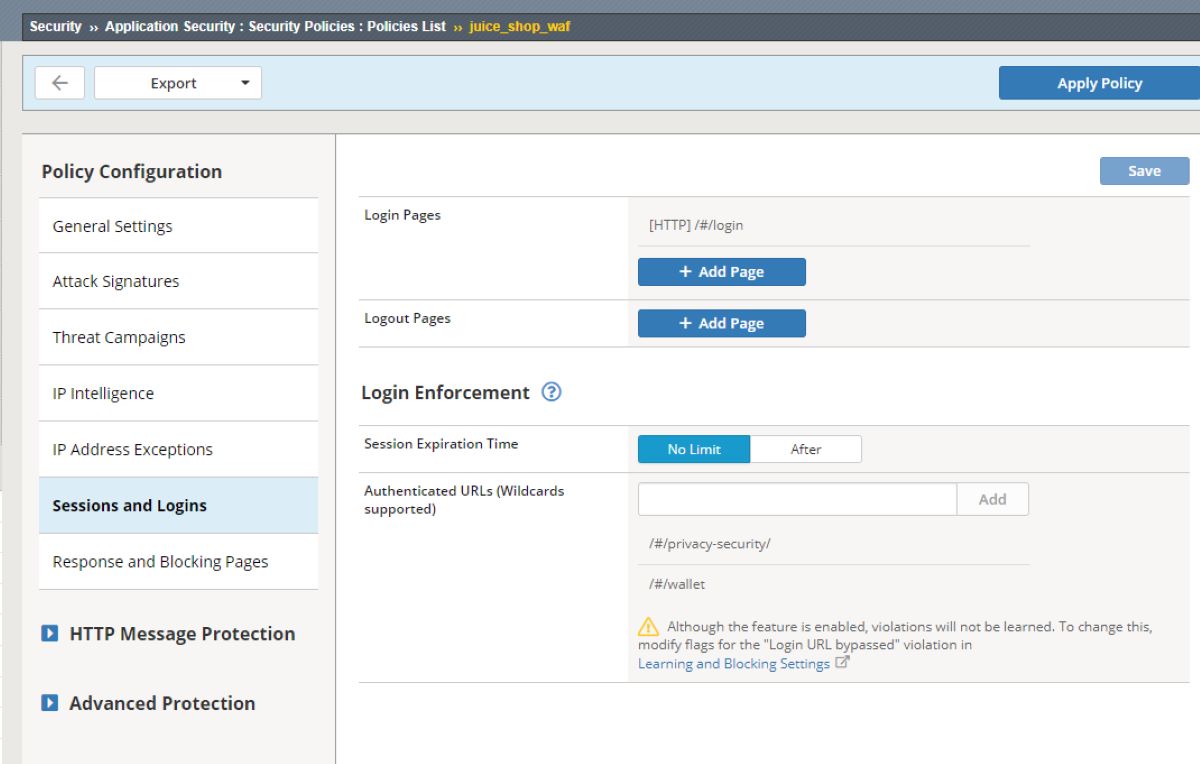
F5 BIG-IP Advanced WAF protects web applications, APIs, and data against threats such as zero-day vulnerabilities, application-layer DoS attacks, threat campaigns, application takeover, and bots. It combines behavioral analytics, machine learning, and threat intelligence, and it can be deployed on hardware appliances, as virtual or software editions on common hypervisors, and in public clouds including AWS, Azure, and Google Cloud.
The platform provides a dedicated dashboard for OWASP Top 10 compliance, guided configurations for common use cases, a learning engine for custom policy building, and granular security policies for microservices and APIs. It is designed to detect attacks that bypass traditional signature-based defenses.
Key features include:
- Behavioral analytics and machine learning: Combines behavioral analytics, machine learning, threat intelligence, and application expertise to detect sophisticated and previously unseen attacks. This helps catch threats that signature-only approaches miss.
- API protocol security: Secures APIs across formats such as REST/JSON, XML, GraphQL, and GWT. This extends protection to modern API-driven application architectures.
- Layer 7 DoS protection: Uses behavioral analysis and machine learning to provide accurate Layer 7 DoS detection and mitigation. This targets application-layer denial-of-service attacks specifically.
- Security as code: Enables declarative, API-based deployment and configuration so security can be delivered as code. This supports automation and consistent policy across environments.
- Credential and bot defense: Protects against brute-force attacks that use stolen credentials and includes proactive bot defense against automated tools. In-browser data encryption further protects against data-extracting malware.
- Flexible deployment and integrations: Runs on hardware appliances, software and virtual editions, and public cloud marketplaces with pay-as-you-go or bring-your-own-license options. It streams telemetry to SIEM, SOAR, and XDR systems for visibility.
Limitations (as reported by users on PeerSpot):
- Configuration complexity: Reviewers report that policy tuning requires experienced engineers, which can be challenging for newer teams.
- Pricing: The product is described as expensive relative to some competing solutions.
- API security scope: Users note that the on-premises product has API-protection gaps and may push organizations toward a separate cloud WAF for full coverage.
- Interface and support: Some reviewers describe the interface as dated and mention support reachability and licensing-clarity concerns.
Source: F5
7. Fortinet FortiWeb

Best for: Fortinet Security Fabric users wanting accelerated WAF
Strengths: Dual-layer ML with bot defense and API protection
Things to consider: Support response and tuning can be inconsistent
FortiWeb protects business-critical web applications and APIs from threats targeting both known and unknown vulnerabilities. It uses a dual-layer machine learning approach that models each application’s behavior to identify malicious patterns and minimize false positives, and it includes anomaly detection, API discovery and protection, bot mitigation, and client-side security.
FortiWeb integrates with the Fortinet Security Fabric, including FortiGate firewalls and FortiSandbox, and adds advanced analytics and a FortiAI-Assist capability for forensics and decision making. It can be deployed as a hardware appliance, virtual machine, container, public cloud instance, or SaaS, with hardware-based acceleration for higher throughput and SSL processing.
Key features include:
- Dual-layer machine learning: Models the behavior of each application to detect malicious patterns and AI-generated zero-day attacks while minimizing false positives. The two-layer approach is designed to prioritize remediation in context.
- Bot defense: Uses bot deception, biometric detection, and machine learning to distinguish legitimate from malicious bots. It aims to do this without slowing users with unnecessary CAPTCHAs or challenges.
- API discovery and protection: Automatically discovers APIs and applies positive-security policies per schema, supporting OpenAPI, XML, and JSON. It integrates into the CI/CD pipeline for ongoing protection.
- Client-side protection: Monitors third-party scripts on payment pages to help meet PCI DSS requirements and detects script injection, DOM manipulation, and form hijacking. This addresses supply-chain and skimming risks on the client side.
- OWASP Top 10 and threat coverage: Protects against OWASP Top 10 threats, DDoS attacks, bot attacks, and skimming. Zero-day protection detects and mitigates unknown attacks in real time.
- Security Fabric integration and acceleration: Integrates with FortiGate firewalls and FortiSandbox and adds advanced analytics and FortiAI-Assist, while hardware-based acceleration supports higher protected throughput and faster SSL processing. FortiGuard AI-powered services add antivirus and anti-botnet protection.
Limitations (as reported by users on PeerSpot):
- Support: Reviewers report that response times and engineer expertise can be inconsistent across regions and time zones.
- Configuration: Fine-tuning the product is described as requiring meaningful effort.
- Reporting: Some users note that reporting capabilities have shortcomings and could be improved.
- Cloud portability: FortiWeb is seen as more on-premises focused, with multi-cloud, SaaS, and high-availability options noted as areas for improvement.
8. Barracuda Web Application Firewall

Best for: Mid-market teams wanting straightforward app protection
Strengths: WAF with bot defense, access control, and app delivery
Things to consider: Interface is dated and support draws criticism
Barracuda Web Application Firewall protects web applications, APIs, and mobile app backends against the OWASP Top 10, zero-day threats, data leakage, and application-layer denial-of-service attacks. It combines signature-based policies and a positive security model with anomaly detection, and an optional Active DDoS Prevention add-on filters volumetric attacks before they reach the network.
The product is part of Barracuda Application Protection and adds access control, hardened SSL/TLS termination, and an application delivery module with load balancing, content routing, caching, and compression. It can be deployed as a physical or virtual appliance, on-premises, and in public cloud, and it integrates with DevOps tools and external SIEM platforms.
Key features include:
- OWASP and DDoS protection: Combines signature-based policies, positive security, and anomaly detection to defend against the OWASP Top 10 and zero-day threats. The Active DDoS Prevention add-on filters volumetric attacks before they reach applications.
- Advanced bot protection: Uses machine learning to distinguish legitimate users and bots from malicious and human-mimicking bots. This allows good traffic through, while blocking automated abuse.
- API and mobile protection: Protects REST and API-based applications with XML and JSON inspection and uses API discovery to auto-create rulesets from definition files. This reduces administrative overhead when securing APIs.
- Access control and secure delivery: Integrates with AD, LDAP, and RADIUS and supports SAML single sign-on and two-factor authentication through providers such as RSA and Duo. A hardened SSL/TLS stack and an application delivery module add load balancing, content routing, caching, and compression.
- Automation and vulnerability remediation: Provides a REST API built on OpenAPI and integrations with Puppet, Chef, Ansible, Terraform, Azure ARM, and AWS CloudFormation, plus one-click remediation through Barracuda Vulnerability Manager and third-party scanners. This supports automated CI/CD rollouts.
- Visibility and SIEM integration: Offers a dashboard with traffic, attack, and system insights and integrates with external SIEMs such as Azure Sentinel, Splunk, and QRadar. This consolidates monitoring and reporting.
Limitations (as reported by users on PeerSpot):
- Support: Some users report dissatisfaction with the responsiveness and quality of technical support.
- False positives: Reviewers note false positives that can block legitimate transactions and generate user complaints.
- Interface: The configuration GUI is described as dated and not always intuitive.
- Policy flexibility and performance: Users cite limited multi-policy support, no bulk configuration, and some load-balancing and connection-pooling performance issues.
まとめ
A reliable web application firewall is critical for defending modern web applications against an expanding range of sophisticated threats. It must deliver high detection accuracy, minimal false positives, low latency, and seamless scalability without disrupting user experience or development workflows. Additionally, robust WAF solutions offer flexibility in deployment and integration, ensuring they can adapt to diverse architectures and threat environments.